


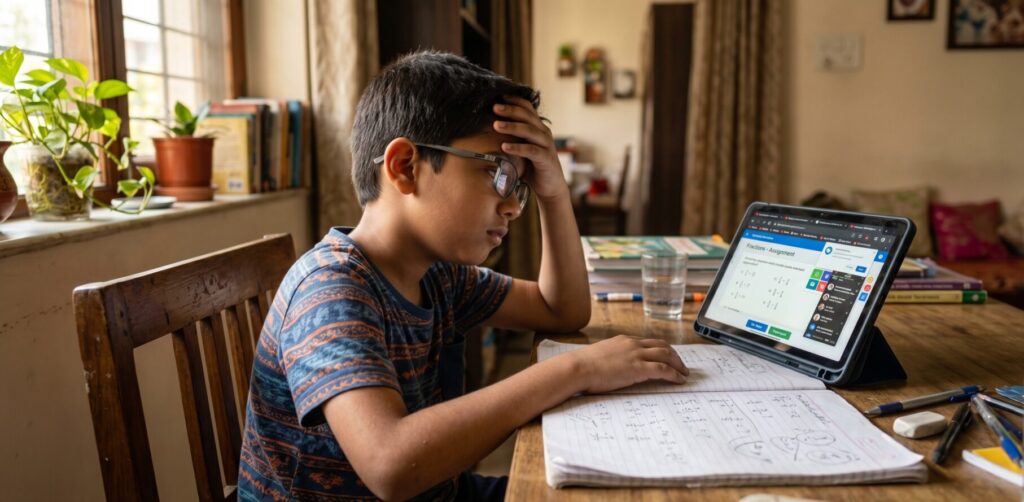
Every Indian parent knows this scene.
Homework time. Screen on. Child at the desk. Looks like studying.
Twenty minutes later, nothing was done. An argument started. Someone frustrated. The evening was ruined.
You are not dealing with a difficult child. You are dealing with a difficult environment.
Screen-based homework is genuinely harder than paper-based homework, and not for the reasons most parents assume. Let us bust the four most common myths about why homework struggles happen on screens and replace each one with what actually helps.
Myth 1: My Child Is Just Being Lazy
The Reality: Their brain is being hijacked before homework even begins.
The moment your child opens a study device, their brain faces something it never faced with a textbook: infinite competing options, all one click away and all more immediately rewarding than homework.
A textbook sits open at one page. It does not recommend other textbooks. It does not send notifications. It does not have a sidebar showing more relevant content.
A screen does all of these things simultaneously.
According to research from the University of California San Diego, the average person encounters the equivalent of 34 gigabytes of information daily through digital screens, creating a cognitive load that depletes the focused attention needed for homework before the first question is even attempted.
Your child is not lazy. Their attention is being consumed before they can devote it to their homework.
What actually helps: Separate the study browser from the entertainment device. Even just using a different user profile can completely change the brain’s association with the device.
Myth 2: They Need More Time to Finish
The Reality: They need less distraction, not more time.
Adding more homework time to a distraction-filled environment does not produce more learning. It produces more time spent in the same unproductive cycle.
A child doing homework with gaming sites available, social media notifications running, and autoplay recommendations loading is not studying inefficiently. They are not studying at all; they are managing distractions while occasionally glancing at homework between interruptions.
The solution is never more time. It is always a cleaner environment.
What actually helps: Close every unnecessary tab. One screen. One subject. One purpose. Set a visible timer for 25 focused minutes followed by a 5-minute break. The Pomodoro structure, short focused bursts with built-in rests, works exceptionally well for screen-based homework because it creates natural stopping points the endless internet never provides.
For more practical homework routine strategies designed for Indian families, the Apni Pathshala blog has detailed guides on building effective digital study habits at home.
Myth 3: If I Check on Them More, They Will Stay Focused
The Reality: External monitoring builds dependence, not habits.
When a parent is the reason a child stays focused, the child focuses only when the parent is there. The moment supervision disappears, so does the focus.
What Indian parents actually need is a system that builds internal accountability, where the child develops their own relationship with their homework routine, independent of whether someone is watching.
Research from Stanford’s Self-Determination Theory studies shows consistently that children who develop intrinsic motivation for learning, through visible personal progress, autonomy over their learning process, and genuine competence experiences, sustain far better homework habits than those motivated primarily by external supervision or reward.
What actually helps: Make homework progress visible to the child themselves. A simple weekly tracker, subjects completed, days consistent, and time focused, gives children ownership over their routine. When children can see their consistency, they begin to protect it without being asked.
Myth 4: The Right Educational App Will Solve This
The Reality: No app fixes a broken homework environment.
India’s parents spend enormous energy finding the best homework apps, the most educational platforms, and the most engaging digital tools for their children. And these tools can genuinely be valuable when the environment around them is right.
But an excellent homework app inside a distraction-filled device is like a brilliant teacher trying to deliver a lesson in a noisy market. When the environment prevents it from being absorbed, the quality of the content becomes irrelevant.
What actually helps: Fix the environment first. Content second.
A structured, distraction-free homework environment makes average content effective. A chaotic, distraction-filled environment makes excellent content useless.
How Apni Prerna Fixes the Homework Environment Automatically
Every insight above points to the same root cause and the same solution.
Screen-based homework struggles because the digital environment was never designed for focused, purposeful study. Apni Prerna redesigns that environment, automatically, from the moment your child sits down.
Here is what changes immediately:
A unique student login creates a homework identity. Your child logs in with their roll number, entering the session as a student with a purpose, not an anonymous browser. The homework routine begins with accountability before a single tab opens.
Distractions are structurally absent. The system blocks gaming, social media, entertainment streaming, and addictive platforms. There are no notifications, no recommended videos, and no competing options. Your child’s attention goes entirely to homework, because that is genuinely the only available option.
Educational and homework tools work instantly. Every approved learning resource, homework platform, and study tool loads smoothly and immediately. The path of least resistance leads directly to the homework and stays there.
Real session data replaces guesswork. Parents receive honest reports, focused homework time, platforms accessed, and consistency tracked week over week. You stop wondering whether homework was actually done. You know, because the data shows you.
Students build their own homework routine. Personal learning dashboards show children their own consistency, days studied, time focused, and progress made. Children who can see their routine begin to own it. The daily battle over homework gradually becomes a daily habit your child maintains independently.
A mother from a learning POD in Gujarat shared what changed for her family:
Before, homework meant a daily fight. Now he sits down by himself, because he knows what to do and the system supports him doing it.
That is a homework routine that works. It works not because of pressure, but because of structure.
Conclusion
Screen-based homework is not harder because your child is unwilling. It is harder because the screen was not designed for homework.
Every distraction, every recommendation, every competing option on that device works against the focused attention homework requires. And the child in the middle of all of it is doing their best against extraordinary odds.
The solution is not more pressure, more monitoring, or more time. It is a better environment, one where homework becomes the natural, easy, supported activity that your child’s evening actually needs it to be.
Apni Prerna builds that environment. Every session. Without the daily battle.
Homework battles end when the environment changes, not when the child changes. Apni Prerna creates a distraction-free homework space automatically every evening.
End the Homework Battle: Discover Apni Prerna
Help your child move from just watching to actually learning. Read the full blog
6 thoughts on “Why Does Homework Feel Harder When Children Study on Screens?”
Loved this perspective. Screen-based learning has benefits, but it also comes with challenges that deserve attention.
Thank you for sharing this. Yes, digital learning works best when it supports focus, balance, and real understanding.
Homework feel hard for sudents because they just physically present at school, colleges or in the coaching classes and literaly nobody ask them what you are learning today (daily update).
Thank you for sharing this. True, students need daily reflection, not just daily attendance.
truth
Thank you for saying that. True, digital learning works best when screen time becomes focused learning time.