


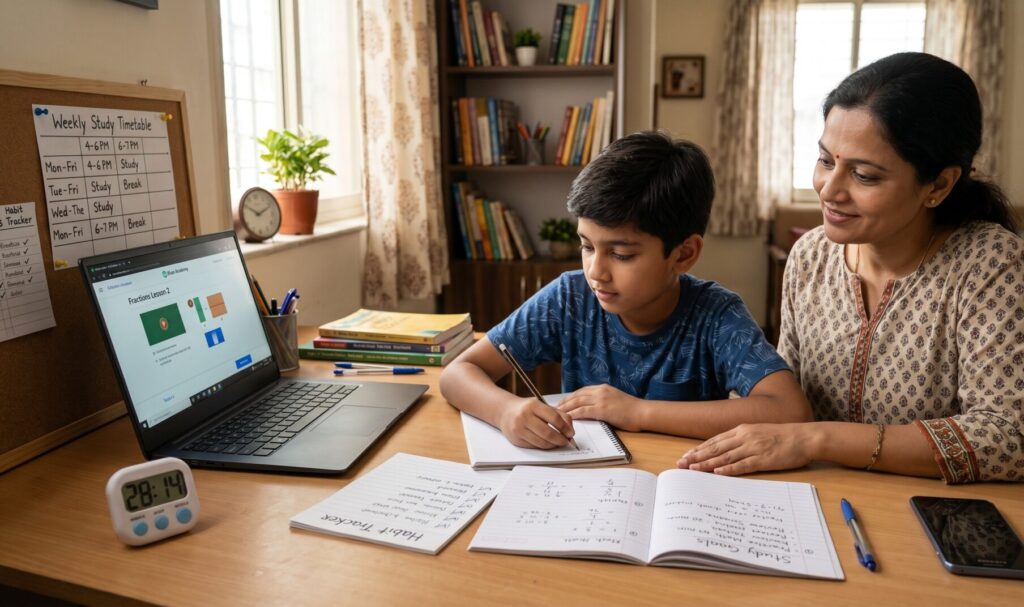
6:30 PM. Your child gets home from school.
Two versions of this evening are possible.
One leads to a productive, calm study session, a child who feels genuinely accomplished, and a parent who is not exhausted from fighting about screens.
The other, well. You already know the other.
The difference between these two evenings is not your child’s mood. It is not their motivation level. It is not even the quality of the homework.
It is whether a study habit exists or does not.
1. Why Digital Study Habits Are Different From Traditional Ones
Building study habits for children was simpler when studying meant books, notebooks, and a quiet corner.
The digital age changed the challenge entirely.
Now studying means a screen, the same screen that plays games, runs social media, streams entertainment, and sends notifications every few minutes. The child is asked to use a distraction machine as a focus tool. And then we wonder why focus does not happen.
According to research by the Central Board of Secondary Education’s academic guidelines on digital learning, students who follow structured digital study routines, with defined start times, clear learning goals, and distraction-free environments, show measurably better academic outcomes than those in unstructured digital study settings.
Good digital study habits must address what paper-based habits never needed to: the environment itself.
2. The Four Habits That Actually Build Better Digital Learners
These are not complicated. They are consistent. And consistency is everything.
Habit 1 — The Pre-Session Intention
Before the screen opens, your child states one specific goal.
Not “I will study.” Instead, I will finish the geography worksheet and read two pages of chapter four. Specific goals activate focused attention. Vague goals invite drifting.
Habit 2 — The Offline Break First
Children who go directly from school to screen never properly transition from passive reception mode to active learning mode.
Thirty minutes offline, physical activity, a snack, and conversation reset the brain for genuine engagement. This single habit reduces homework resistance by removing the “I need to decompress” excuse that extends screen time indefinitely.
Habit 3 — The Single-Tab Rule:
One subject. One platform. One tab open.
Every additional tab is a standing invitation to drift. Remove the invitation. The child’s focus goes where the environment points, so point it somewhere useful.
Habit 4 — The End-of-Session Review
One question closes every study session: “What is one thing I learned today that I did not know this morning?”
This question forces active recall, the single most powerful memory consolidation technique available. It also gives children a daily experience of genuine accomplishment that builds intrinsic motivation over time.
For detailed guides on building these habits with Indian children at different age groups, the Apni Pathshala blog has practical frameworks written specifically for Indian families and learning environments.
3. Why Environment Matters More Than Motivation for Study Habits
Here is the honest truth about habit-building that most advice skips.
Motivation is unreliable. The environment is consistent.
A child who relies on motivation to study will study well some days and poorly on others, depending on mood, energy, social dynamics, and dozens of other variables outside their control.
A child whose study environment is structured, where the right tools are accessible and the wrong ones are not and the routine is predictable, builds habits through repetition rather than willpower.
The National Council of Educational Research and Training (NCERT) consistently emphasizes in its pedagogical guidelines that structured, routine-based learning environments produce stronger habit formation and better academic outcomes than motivation-dependent approaches, particularly for children in the 8–14 age group.
The environment does not just support the habit. For children, the environment is the habit.
4. How Apni Prerna Builds These Study Habits Automatically
Every habit described above requires three things to work consistently: structure, accountability, and a distraction-free environment.
Apni Prerna delivers all three, automatically, every session, without daily parental enforcement.
The moment your child logs into an Apni Prerna-powered computer, all four habits activate by design:
The intention is built into login. Every student enters the session with a unique roll number, their identity, and their learning record. Before a single page loads, the session has a purpose. The pre-session intention habit is already triggered.
Distractions are structurally impossible. Gaming, social media, entertainment, and non-educational content are blocked at the system level before they appear. The single-tab rule is enforced by the environment, not by the child’s willpower or the parent’s vigilance.
Only productive tools are accessible. Educational platforms, AI learning assistants, and structured study resources, everything that supports genuine study habits, load instantly. The easiest way to learn is the only way to learn.
Progress makes the end-of-session review natural. Students see their learning data on a personal dashboard, study time, platforms used, and consistency tracked week over week. The “What did I learn today?” question answers itself, because the data shows exactly what happened.
Parents see real session reports. No guessing. No assumptions. Honest weekly summaries of focused study time, platforms accessed, and consistency trends, so every parenting conversation is informed, supportive, and productive rather than anxious and reactive.
A teacher from a community learning centre in Hyderabad described the transformation in her students:
Before, children opened the screen and got lost. Now, after Apni Prerna, a routine has formed. They know what to do. And they do it.
That is the power of environment-built habits. Not forced. Not fought for. Simply designed.
Conclusion
The digital age did not make study habits impossible. It made them more important and more specific than ever.
Good study habits for children today are not about sitting still for longer or trying harder on a distraction-filled screen. They are about building a simple, consistent, environment-supported routine that makes focused learning the automatic outcome of every evening.
Four habits. One consistent environment. One system that runs it automatically.
That is the study habit fix every Indian family needs in the digital age. And it is available starting tonight.
The right study habits start with the right environment.
Apni Prerna builds that environment automatically, so tonight’s study session is different from last night’s.
Learn how families are making digital education more effective with Apni Prerna.
Build Better Study Habits Starting Tonight: Discover Apni Prerna
8 thoughts on “How to Build Better Study Habits for Children in the Digital Age”
We have to take action to measure our kids growth either weekly or monthly basis becaude it’s our responsiblity.
Thank you for sharing this. You’re absolutely right, tracking children’s growth weekly or monthly helps parents understand their learning better and support them at the right time.
Really loved this perspective. Strong study habits built early can make a lifelong difference for children.
Thank you so much. Completely agree, small habits built early can quietly shape a child’s confidence and learning for years.
nice tool
Thank you so much! Glad you found it useful. Apni Prerna is built to help children learn better with the right digital support.
we can start doing little habbit with kids like
– Daily 15m typing practice
– Learn daily new 10 to 15 words.
– record your own video about daily routine
Thank you for sharing. These small daily habits can really help kids build confidence and consistency.