


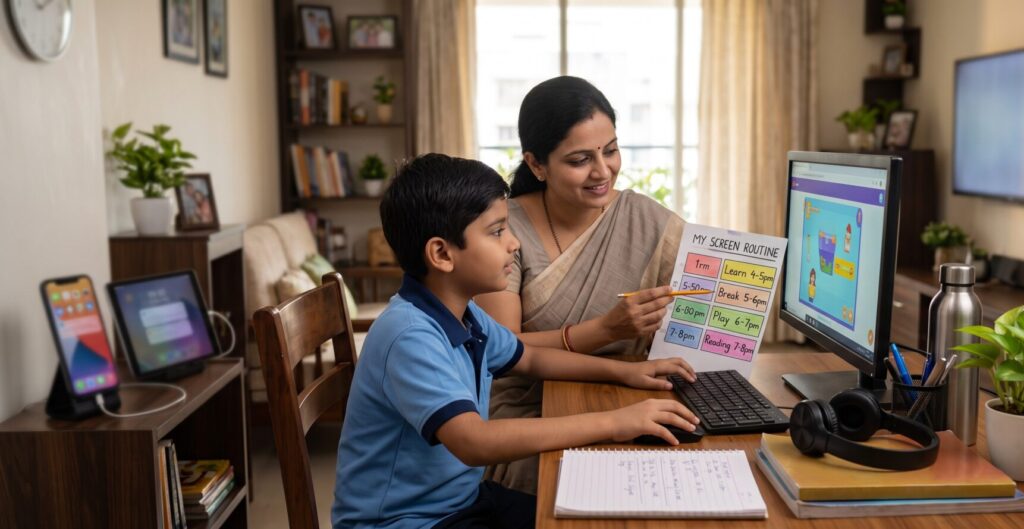
Your child is growing up with screens. That is not a problem to solve. It is a reality to navigate.
The parents who navigate it well are neither the strictest nor the most lenient. They are the most intentional ones, parents who made a few smart decisions early and let those decisions do the heavy lifting every day after.
Here is the playbook.
Helping Parents Guide Screen Use With Smarter Habits
Rule 1 — Guide the screen. Do not fight it.
Every parent who has tried to simply take screens away knows what happens next. Resistance. Negotiation. The screen comes back anyway, with resentment attached.
Smart parenting does not fight the screen. It guides what happens on the screen by designing the environment before the argument begins.
Ask yourself one question this week: “Is my child’s screen designed for learning, or is it a gaming device with a homework tab occasionally opened?”
The answer tells you exactly what needs to change.
Rule 2 — Set the purpose before the session, not during it.
The single most effective smart parenting habit available costs thirty seconds.
Before your child opens the device, one question: “What will you finish today?”
Not “how long will you study.” What. Will. You. Finish.
Purpose before the session changes everything that happens during it. A child with a specific goal behaves differently on a screen than a child who opens the device and waits to see what calls to them first.
According to research from India’s National Council of Educational Research and Training (NCERT), students who enter digital learning sessions with clearly defined objectives demonstrate significantly higher task completion rates and better learning retention than those without pre-session goals.
Apni Prerna builds this habit structurally; every student logs in with a unique roll number, creating identity and session purpose before a single page loads. The pre-session intention is not left to chance. It is built into the environment.
Simple Ways to Build Healthy Digital Habits in Kids
Rule 3 — Build the habit through environment, not willpower.
Telling a child to resist entertainment when it is one click away requires them to make the right decision dozens of times per session. They will fail, not because they are weak, but because that is how human attention works.
Smart parenting removes the decision entirely.
Three environment changes that take ten minutes to implement and last indefinitely:
- Separate study profiles from entertainment profiles on the same device, different login, different associations, different brain state
- Remove gaming and social media shortcuts from the study desktop entirely; out of sight reduces temptation by removing the visual trigger.
- Set a physical boundary — a specific chair, a specific desk, a specific time that belongs only to focused learning; the location becomes the cue.
Habits form through the repetition of cues and behaviours. Build the right cue into the environment and the right behaviour follows automatically.
Rule 4 — Track learning, not screen time.
Screen time is the wrong metric and most Indian parents are measuring it obsessively.
Two hours of focused, active learning and two hours of passive entertainment scrolling are both “two hours of screen time.” They produce completely different outcomes.
Smart parents track what was learned, not how long the screen was on.
Research published by the Digital Empowerment Foundation India shows that parents who shift from monitoring duration to monitoring learning quality report significantly higher satisfaction with their child’s digital education and measurably better academic outcomes over time.
Ask one question after every session: “What is one thing you learned today?”
If they can answer specifically, learning happened. If they cannot, the environment needs attention, not the child.
Smart Parenting for Safer and Better Screen Learning
Rule 5 — Safety and learning are not separate conversations.
Most parents treat online safety as one topic and online learning as another. Smart parents understand they are the same conversation.
An unsafe digital environment is also an unproductive learning environment, because every unsafe or distracting element threatens the focus that genuine learning requires.
Safe screens are focused screens. Focused screens are learning screens.
Apni Prerna was designed around exactly this principle. Harmful content, gaming platforms, social media, and addictive sites are blocked at system level, not as a punishment, but because a learning environment that contains these elements cannot function as a learning environment. Safety and structure arrive together, by design.
Rule 6 — Stay connected without hovering.
The goal of smart digital parenting is not to watch every click. It is to stay genuinely informed about what your child is building online, without turning every study session into a supervision event.
Informed parenting looks like this:
- Weekly five-minute review of your child’s learning data together, not as an audit, but as a conversation
- Monthly check-in on what skills are developing, “show me something you made this month”
- Real session reports that answer the question without you having to ask it.
Apni Prerna gives parents exactly this visibility: honest session data showing focused learning time, platforms accessed, and consistency tracked week over week. You do not hover. You do not guess. You simply know.
A parent from a community POD in Karnataka shared what this changed:
Before, she had to ask every day, what did you do? How much did you do? Now everything is on the dashboard. And her child knows she can see it, so he takes it more seriously.
Visibility creates accountability. Accountability builds habit. Habit produces growth.
How Parents Can Balance Screens, Learning, and Growth
The balance between offline and online time is not equal.
Balance in the digital age means quality over quantity, fewer hours of purposeful, structured, guided screen time producing more genuine growth than twice the hours of unstructured access ever could.
Smart parents do not count minutes. They design environments, ask purposeful questions, track real learning, and let a well-built system handle the rest.
That system is Apni Prerna. And it is already working for thousands of Indian families, one smart session at a time.
Smart parenting in the digital age starts with one smart decision: building the right environment for your child’s screen time.
Apni Prerna does that automatically. Every session. Without the daily battle.
Explore More: A Smarter Way to Support Your Child Online
Start Smart Digital Parenting Today — Discover Apni Prerna
2 thoughts on “Smart Parenting Tips for Children Growing Up With Screens”
nice vlog
Children don’t just need screen limits they need digital guidance.