


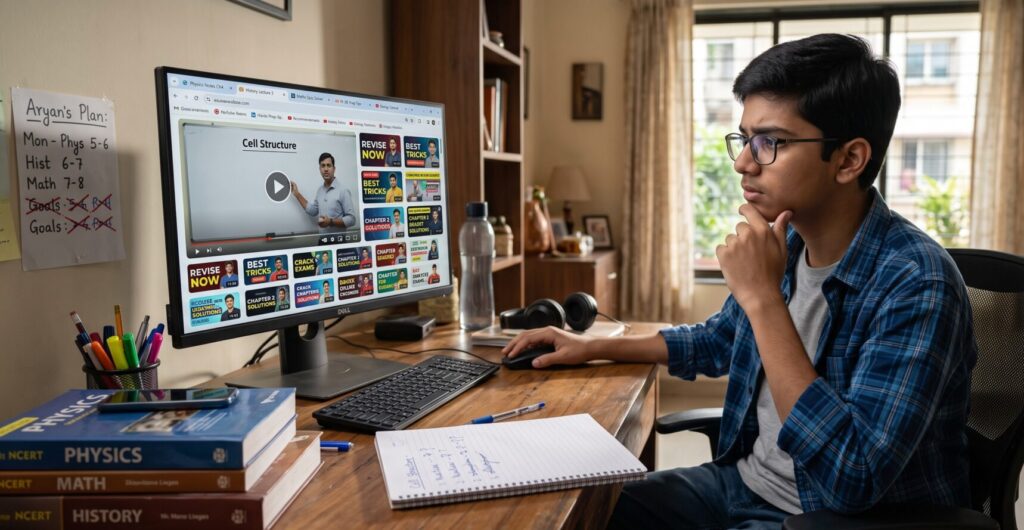
Watch a child learning online for ten minutes.
Clicks. Scrolls. Tabs opening. Videos loading. Pages switching.
Looks like learning. Feels like studying. Produces almost nothing.
This is the central paradox of digital education: the more available learning becomes, the easier it is to feel busy without actually going anywhere.
Why Online Learning Feels Busy but Shows Less Progress
Busyness is not progress. Clicking is not learning.
Here is the honest reality of what most children’s online study sessions actually look like:
| Three tabs open | Attention split three ways |
| Watching an explanation video | Brain in passive reception mode |
| Scrolling through study notes | Exposure without retention |
| Clicking between platforms | Constant restart, zero depth |
| Two hours at the screen | Twenty minutes of actual focus |
The digital environment creates what researchers call “the illusion of productivity”, in which the sheer volume of activity convinces both the child and the parent that learning is occurring, even though retention is actually close to zero.
According to NCERT’s National Curriculum Framework guidelines, genuine learning requires sustained engagement with a single concept rather than rapid movement among multiple content sources. Depth beats breadth. Every time.
Apni Prerna addresses this directly. By blocking non-educational platforms at the system level and giving students one structured learning path to follow, it removes the click-between-everything habit before it forms, replacing fragmented busyness with focused, single-direction progress.
Helping Students Avoid Common Digital Learning Mistakes
The mistakes are not careless. They are structural.
Most digital learning mistakes happen not because children are lazy, but because the online environment was never designed to prevent them.
The three most common digital learning mistakes Indian students make every day:
Mistake 1 — Re-watching instead of practising.
When confused, the instinct is to watch the explanation again. But passive re-exposure rarely produces new understanding. Attempting the problem, getting it wrong, correcting it- that is what actually builds the skill.
Mistake 2 — Confusing completion with comprehension.
Finishing a module, reaching 100%, earning a badge- none of these confirms understanding. A child can complete ten lessons and understand none of them. Completion is a quantity measure. Learning is a quality measure.
Mistake 3 — Learning without applying.
Content consumed without immediate application disappears rapidly. Within 24 hours, unapplied information drops below 20% retention for most learners. Knowledge needs a place to land, a problem to solve, a concept to explain, something to build.
Research from the Association for Psychological Science confirms that application within the same session as learning produces retention rates three to four times higher than passive review alone.
Inside Apni Prerna, these mistakes are structurally prevented. The platform prioritises active learning tools, coding exercises, problem sets, and AI-guided practice sessions over passive content streams. Students do not just watch learning happen. They are the ones making it happen.
How Better Learning Habits Can Improve Online Study
Habits are built by the environment, not by willpower.
Three small habit shifts that produce outsized improvements in online learning:
One goal before every session. Not “study science.” Instead, “understand and explain the water cycle in three sentences.” Specific goals activate focused attention. Vague goals invite clicking around without direction.
One tab. One subject. One purpose. Every additional open tab reduces cognitive focus available for the primary task. Close everything irrelevant. The child’s brain goes where the environment points; point it somewhere useful.
One recall question at the end. Before closing the screen, “What is one thing I can explain right now that I couldn’t this morning?” If the answer is nothing, the session was clicking, not learning. If the answer is something specific, real learning happened.
These three habits, practised consistently, change the entire quality of a child’s online study, without adding a single extra minute of screen time.
Why Children Need Purpose, Not Just Clicks, While Learning Online
Purpose is what separates a click that builds something from a click that goes nowhere.
A child with purpose opens the screen knowing exactly what they are there to accomplish. Every click moves toward that goal. The session ends with something specific completed, something the child could not do or explain before they started.
A child without purpose opens the screen and follows whatever pulls their attention next. Every click is a reaction, not a decision. The session ends with nothing specific built, just time spent and energy consumed.
The internet offers both experiences with equal ease. The only variable is whether a purposeful structure exists before the session begins.
This is the core principle behind Apni Prerna: every session begins with student identity through a unique roll-number login, creating purpose and accountability before a single page loads. Every tool accessible inside the environment requires active engagement. Every session generates honest data showing whether real learning happened or just clicking did.
A student from a learning POD in Rajasthan described the shift simply:
“Pehle screen kholte hi nahi pata tha kahan jaana hai. Ab seedha kaam pe aa jaata hoon.”
Before, opening the screen meant not knowing where to go. Now he goes straight to work.
That is purpose replacing clicks. That is learning replacing busyness.
Conclusion
Children are not learning less online because they are trying less.
They are learning less because the digital environment rewards clicking rather than thinking. Busyness, not progress. Completion, not comprehension.
The fix is not more content or more screen time. It is purpose, clear, structured, and built into every session from the first moment the screen turns on.
Apni Prerna builds that purpose into the environment automatically, so every click your child makes online moves them genuinely forward.
Your child is clicking. But are they learning?
Apni Prerna replaces aimless clicking with purposeful, structured digital learning, automatically, every session.
Looking for more smart parenting tips? Explore our guide on managing children’s screen time and building healthy digital habits. Click here
Every click your child makes should move them closer to learning, not distraction. Discover how Apni Prerna creates a safe, structured digital environment that helps students stay focused, build better learning habits, and make every online study session count. Explore Apni Prerna today.
2 thoughts on “Why Do Children Click More but Learn Less Online?”
nice vlog
A meaningful reminder that learning is about understanding, not just screen activity.