


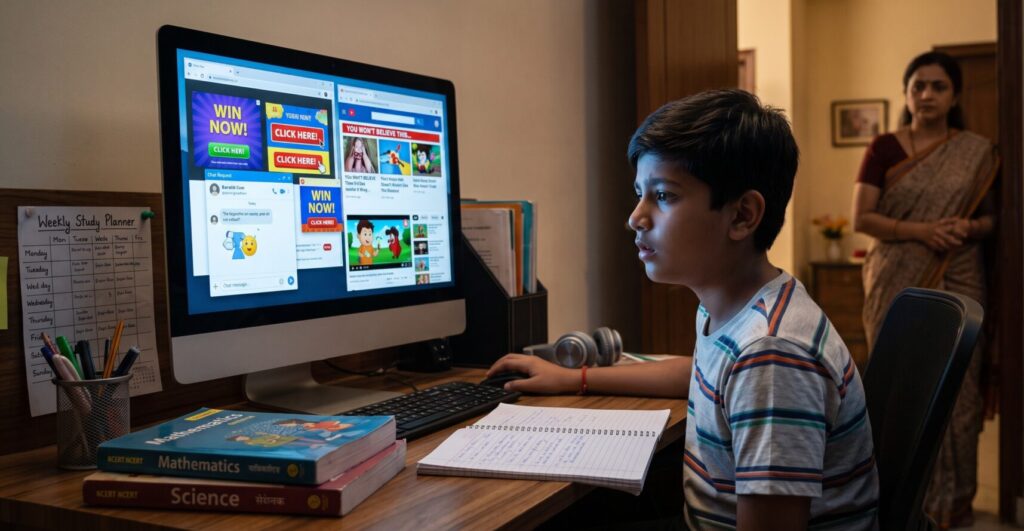
The risk never announces itself.
It does not arrive with a warning. It does not happen in a single dramatic moment that you can point to and say, “That is where things went wrong.”
It happens gradually. Quietly. In the thirty minutes before dinner when nobody is watching. In the hour after school when the device is open, and the house is busy. In the session that started as homework and ended somewhere entirely different.
By the time most Indian parents notice something is wrong, months of unsupervised internet access have already shaped habits, consumed attention, and quietly eroded the learning time they assumed was happening.
Here is what those hidden risks actually look like, moment by moment, before they become a crisis.
When Internet Access Turns Into Digital Risk?
It starts with one harmless click.
A child opens a science video. The algorithm recommends another. Then another. Twenty minutes later, the content is unrelated to science, moderately inappropriate, and the child has no idea how they got there.
This is not rare. This is Tuesday.
According to research by the Internet Watch Foundation, children with unsupervised internet access encounter inappropriate content within their first weeks of use, not through deliberate searching, but through algorithmic recommendation and accidental exposure. The open internet does not distinguish between a ten-year-old and an adult. It serves content based on engagement data, not age appropriateness.
The first hidden risk of unsupervised access is not the content a child searches for. It is the content that finds them, quietly, repeatedly, before any adult notices.
Apni Prerna removes this risk structurally. Harmful and inappropriate content is blocked at system level before it loads, not after a child has already encountered it. The path the algorithm would have taken simply does not exist in this environment.
Why Children Need Guidance Before Online Freedom?
Freedom without preparation is not opportunity. It is exposure.
Every Indian parent wants their child to be digitally confident and capable. But there is a sequence to this: guidance must come before freedom, not after the consequences of freedom have already arrived.
A child given unsupervised internet access before being taught how to navigate it is not being empowered. They are being placed in the world’s most complex information environment, alone, with no map and no compass.
UNICEF’s research on children’s digital rights and online protection is unambiguous: children navigating digital environments without structural guidance or parental awareness are significantly more vulnerable to harmful content, online manipulation, and the development of unhealthy digital habits than those with guided access.
Guidance does not mean surveillance. It means designing the digital environment your child enters so that their first experiences online build confidence, not vulnerability.
Three things children need before internet freedom:
- A bounded environment where unsafe content cannot reach them accidentally
- A learning identity — sessions tied to their name, their progress, their record
- Visibility tools that let parents stay informed without standing over their shoulder
The Learning Loss Behind Unchecked Screen Use
This is the hidden risk most parents discover too late.
It is not always dramatic. There is no single incident. There is just a child who spent six months with daily internet access and cannot show you what they learned from it.
Unchecked screen use does not just expose children to inappropriate content. It trains their attention away from learning. Every hour spent in passive, unstructured digital consumption is an hour the brain spent in entertainment mode, not learning mode.
Over months, this compounds into something serious.
Attention spans shorten. The ability to sustain focus on difficult material decreases. The habit of switching content when something becomes challenging, rather than pushing through, becomes deeply ingrained.
According to India’s National Commission for Protection of Child Rights (NCPCR), children between ages 6 and 14 spending significant daily time on unsupervised screens show measurable declines in reading engagement, classroom focus, and independent problem-solving ability compared to peers with structured digital access.
The learning loss from unchecked screen use is invisible on the surface, until it shows up in results, in classroom behaviour, and in a child who has spent hundreds of hours online but built nothing from them.
How Parents Can Create a Safer Digital Learning Space
Safety is not a rule. It is a design.
The parents who successfully protect their children online are not the ones who check browser history at 11 pm or enforce the strictest time limits. They are the ones who designed the digital space their child enters, before the risks had a chance to take hold.
Four design decisions that change everything:
Decision 1 — Separate the study device from the entertainment device. Even on the same hardware, different user profiles create different brain states. The study profile should have zero entertainment associations.
Decision 2 — Block before the session begins, not during it. Reactive content filtering, where a parent checks what a child accessed after the fact, is always too late. Structural blocking before content loads is the only prevention that works consistently.
Decision 3 — Make every session accountable. Anonymous internet use invites aimless behaviour. Sessions tied to a student identity, a name, a roll number, a learning record, produce fundamentally different behaviour from the first moment.
Decision 4 — Give visibility without surveillance. Parents who receive honest session reports– what was accessed, how long the focus was sustained, what was actually learned—do not need to hover or interrogate. They already know.
This is exactly what Apni Prerna delivers for Indian families.
Every session begins with a unique student roll-number login, instantly creating identity and accountability. Harmful content is blocked at the system level before it appears. Educational tools load smoothly and immediately. Parents receive real learning reports, not screen time totals, but honest data on focused study, platforms used, and consistency building week over week.
A parent from a community POD in Maharashtra described what changed after Apni Prerna:
Before, she was afraid; she had no idea what her child was seeing. Now the system handles it. She just watches the progress.
That shift, from fear to confidence- is what the right digital environment produces.
Conclusion
The hidden risk of unsupervised internet access is not one dramatic event.
It is a hundred quiet moments, inappropriate content encountered accidentally, attention trained toward distraction, learning time consumed by passive scrolling, that compound invisibly until the damage is already done.
The solution is not removing internet access. It is designing internet access deliberately and structurally before the risks have a chance to arise.
Apni Prerna automatically builds that design for every Indian child, creating a safer, smarter, more purposeful digital learning environment from the very first login.
Do not wait for a problem to tell you the internet was unsupervised.
Apni Prerna builds a safe, guided digital learning space for your child, automatically, every session.
Want to understand how digital report cards can help parents track their child’s real learning progress?
Make your child’s internet time safer, focused, and learning-first with Apni Prerna.
Explore Apni Prerna today and give your child a guided digital space built for real learning.