


I want to talk to you honestly, not as an expert or a brand, but as someone who understands what you face every evening.
Your child is at the screen. They look engaged. The device is on. Something is happening.
But you have that quiet, nagging feeling that none of it is going anywhere.
They are browsing. Not learning. Clicking. Not building. Moving through content like you move through a crowded market, absorbing noise and buying nothing.
You are not imagining it. And you are not alone.
The Difference Between Browsing and Purposeful Learning and Why It Changes Everything
Here is the simplest way to understand the gap.
Browsing is what happens when a child opens a device with no direction. The algorithm decides what comes next. Attention follows the most stimulating option available. Sessions end without a clear outcome, and the child could not tell you what they actually did for the past hour.
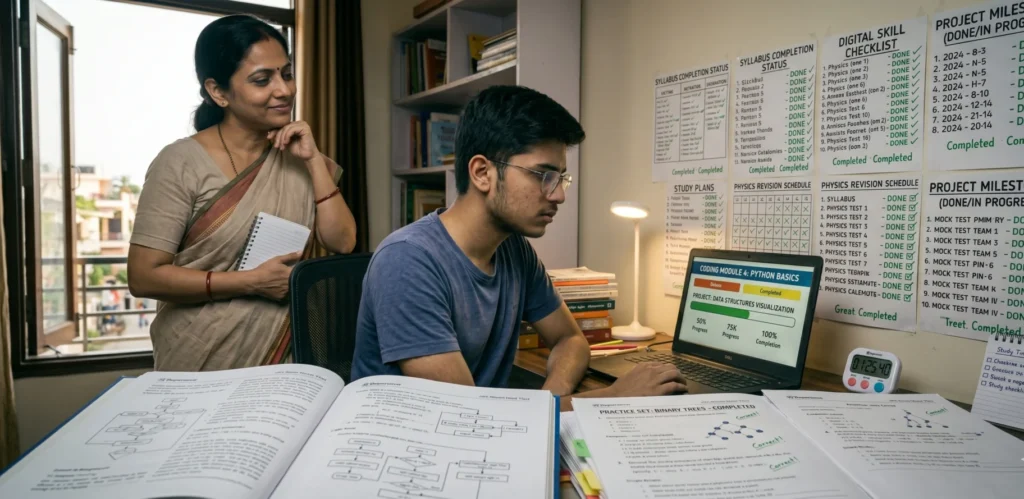
Purposeful learning is what happens when a child opens a device knowing exactly what they are there to build. There is a direction. There is a goal. There is something to show for the time when the screen closes.
The difference is not the device. It is not even the content.
It is the presence or absence of intention before the session begins.
One question changes everything: “What will you learn today, and how will you know when you have learned it?”
That question takes twenty seconds. It shifts your child from a passive consumer into an active learner before they have opened a single tab.
Why Children Default to Browsing, Even When They Mean to Study?
This is the part most parenting advice skips over.
Children do not choose random browsing over purposeful learning because they are lazy. They choose it because the digital environment makes browsing frictionless and learning effortful.
Every entertainment option loads instantly. Every recommendation is perfectly calibrated to their interests. Every platform is designed by teams of engineers whose only job is to make staying on it feel better than leaving.
Learning, by contrast, requires effort. Discomfort. Confusion before clarity. The brain naturally moves away from discomfort when a more comfortable option is one click away.
According to research from the University of British Columbia, children and adolescents in unstructured digital environments default to passive consumption within an average of six minutes, regardless of their original learning intention. The environment, not the child, drives the behavior.
This is not a character flaw. This is entirely predictable human neuroscience.
The fix is not asking your child to try harder. It is removing the frictionless alternatives, so purposeful learning becomes the easiest available option.
For practical strategies on creating purposeful learning environments at home, the Apni Pathshala blog has detailed guides written specifically for Indian families navigating exactly this challenge.
Four Simple Shifts That Turn Browsing Into Purposeful Learning
These are not complicated systems. They are small environmental changes that compound over time.
Shift 1 — Set the intention before the screen turns on. Not “go study.” Instead: “Today you will finish two coding exercises” or “Today you will read one article and explain it back to me.” Specific intention creates specific behavior.
Shift 2 — Make the learning goal visible. Write it on a sticky note next to the screen. When the goal is physically visible, the child’s brain returns to it automatically every time attention drifts. A visible goal is an anchor.
Shift 3 — Close everything not related to the goal. One tab. One platform. One purpose. This single environmental change reduces off-task behavior by removing the visual invitation to drift.
Shift 4 — End every session with one sentence. “Today I learned ___.” If your child cannot complete that sentence, the session was browsing, not learning. Both of you know the answer now. And knowing is the first step to changing it.
The System That Makes Purposeful Learning Automatic: Not Just Occasional
Here is the honest truth about these four shifts.
They work brilliantly on the days you have energy, presence, and consistency. They work less well on the days you are exhausted, distracted, or simply not there.
And parenting has a lot of those days.
This is where Apni Prerna becomes the parent’s most valuable partner.
Apni Prerna is student safety software built specifically for Indian children, and it makes purposeful learning the automatic, structural outcome of every digital session, regardless of the day you are having.
Here’s what it does quietly, every session, without you having to enforce anything:
It starts every session with identity and intention. Your child logs in with a unique student roll number. The session has an owner and a purpose before a single page loads. The brain enters learning mode, not because you reminded it, but because the environment demanded it.
It removes the frictionless alternatives entirely. The system blocks gaming, social media, entertainment streaming, and addictive platforms. Not hidden behind a warning. Simply unavailable. Your child does not choose learning over browsing. Browsing is not an option. Learning is what remains.
It makes guided learning tools instantly accessible. Coding platforms, AI learning assistants, structured educational resources, and everything that produces real, purposeful progress loads smoothly and immediately. The path of least resistance leads forward.
It gives both of you visibility into your actual progress. Your child sees their learning data on a personal dashboard, building the self-awareness and intrinsic motivation that purposeful learners need. You receive honest session reports, focused learning time, platforms used, and consistency trends, so your conversations are informed, not anxious.
According to Harvard’s Project Zero research on purposeful learning, children who can see their thinking and learning processes, through structured reflection and visible progress data, develop significantly stronger learning habits and deeper understanding than those without this visibility.
Apni Prerna makes this visibility standard. Not occasional. Every session.
A father from a community learning POD in Rajasthan shared this:
Before opening the screen, his son now asks: “What is today’s work?” That one question changed everything.
That is purposeful learning. That is what Apni Prerna builds, one session, one question, one small habit at a time.
Conclusion
Dear Parent, you already know the difference between a child who browses and a child who learns.
You see it in their eyes when they close the screen. One looks vaguely satisfied but cannot tell you why. The other looks genuinely proud of something specific they built.
The second child is not more gifted. They are more guided.
Purposeful learning is not a talent. It is an environment. And Apni Prerna builds that environment for every Indian child who deserves more from their time online.
You have done the hard part; you gave your child access to the digital world.
Now give them the structure to navigate it with purpose.
You gave your child a screen. Now give them a direction. Apni Prerna turns every digital session into purposeful, measurable learning, automatically.
Read more to learn how students grow faster when technology combines with structure, support, and purpose.