


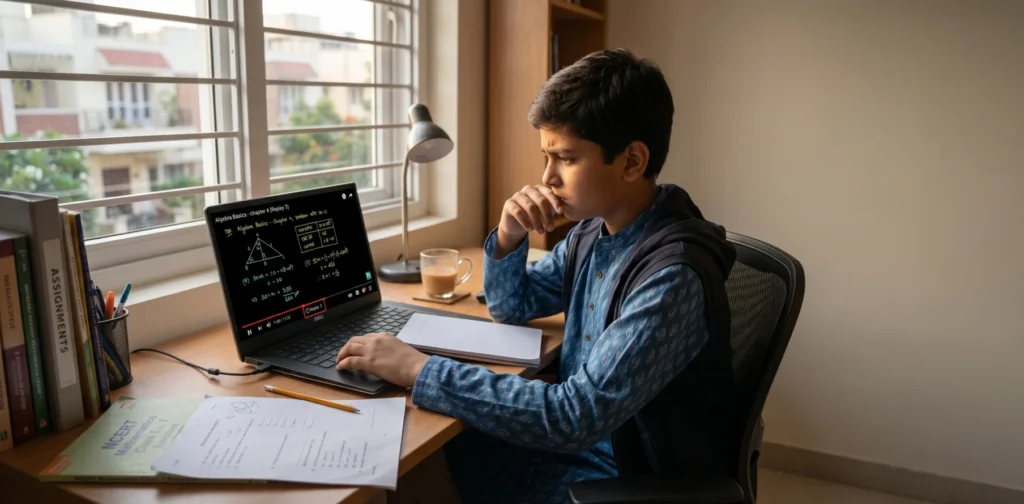
Meet Riya.
She is twelve years old. Bright, curious, and genuinely wants to do well in school.
Every evening, Riya sits at the family computer for ninety minutes. She opens her science lesson, a well-made video about photosynthesis. She watches it carefully. She even rewinds twice to catch a part she missed.
The next morning, her teacher asks, “Riya, explain what chlorophyll does.”
Silence.
Not laziness. Not carelessness. Riya genuinely cannot recall what she watched less than twelve hours ago.
Her mother is baffled. Her teacher is frustrated. And Riya, who tried, who really did try, feels like something is wrong with her.
Nothing is wrong with Riya.
Something is wrong with how we perceive online learning.
Watching a Lesson and Learning It Are Two Different Brain Activities
Here is the part nobody explains to parents.
When Riya watches that photosynthesis video, her brain processes it the same way it processes a movie, as an experience to observe, not information to store.
The brain has two distinct modes: passive reception and active encoding. Passive reception is what happens during watching. Active encoding is what creates a retrievable memory.
The switch between these two modes does not happen automatically. It requires something to trigger it: a question, a problem to solve, an attempt to explain, a moment of confusion, and correction.
Without that trigger, the lesson passes through Riya’s working memory and disappears not due to inattention but because her brain had no reason to store it permanently.
According to research from Washington University’s Memory Lab, students who passively read or watch learning material retain approximately 10% after one week. Students who are prompted to recall the same material actively retain over 50%. Same content. Completely different memory outcomes.
Watching three times does not help. Active recall once changes everything.
The Study Habit That Changes How Much Children Remember
Back to Riya.
What if, halfway through that photosynthesis video, the session paused, and a question appeared on screen?
“Without looking at the video, what does chlorophyll do?”
Riya tries to answer. She gets it partially wrong. The video resumes and corrects her.
That single moment of struggle, of her brain reaching for an answer it did not quite have, encodes the information more powerfully than watching the explanation five times ever could.
This is called retrieval practice, and it is the single most well-documented learning improvement technique in educational psychology.
The Association for Psychological Science confirms retrieval practice produces stronger long-term retention than re-reading, re-watching, highlighting, or any passive review method for children and adults alike.
The study habit that enhances online learning retention is not simply watching more attentively. This habit involves attempting to recall information before you feel fully prepared and allowing the struggle to facilitate learning.
Practical ways to build this habit at home:
The Pause-and-Predict method. Pause the video every five minutes. Ask your child: “What do you think comes next?” The prediction attempt creates active encoding before the answer arrives.
The Teach-Back exercise. After any online lesson, please explain it to me as if I have no prior knowledge of the topic. Children who cannot explain a concept have not yet learned it, so now both of you know exactly where to focus next.
The next-day recall test. Twenty-four hours after a lesson: one question. No looking up. Just attempting to recall. The attempt itself, right or wrong, strengthens the memory far more than reviewing the notes.
For more practical study habit strategies designed for Indian students, the hidden problem covers research-backed learning techniques written specifically for the Indian education context.
Why the Digital Environment Makes Forgetting Even Worse and What Fixes It
Riya’s forgetting problem is not just about how she learns. It is about where she learns.
The same device she uses to study photosynthesis also plays games, runs social media, and streams videos. Her brain cannot enter deep learning mode on a device it has been trained to associate with entertainment.
Additionally, the constant low-level distraction from available options that are just one click away means that Riya’s brain is never fully in the focused, alert state required for active encoding.
The environment is working against her memory before the lesson even begins.
This is exactly the gap Apni Prerna closes for Indian students.
Apni Prerna creates a distraction-free, purpose-built digital learning environment where the conditions for real memory formation are present every single session:
Unique student login shifts the brain into learning mode immediately. Riya is not an anonymous browser. She is a student with an identity and a session purpose. That identity shift activates focused attention before a page loads.
Entertainment is structurally absent. Gaming, social media, and streaming platforms are blocked at the system level. Riya’s brain is not fighting competing associations. The environment says clearly this space is for learning. And the brain responds accordingly.
Active learning tools replace passive video platforms. Instead of watching a lesson and hoping it sticks, Riya works through tools that require application, practice, and retrieval the exact cognitive triggers that create lasting memory.
A personal learning dashboard makes progress visible. Riya can see what she studied, how consistently she showed up, and how her focus is improving week over week. Visible progress builds the confidence to keep going, and assurance sustains the focused attention that makes memory possible.
A parent from a learning POD in Pune described watching this transformation in her daughter:
Before, she would say, “I studied,” but nothing stayed. Now, a week later, she still remembers what she learned. Something has genuinely changed.
That something is the environment.
Conclusion
Riya is not forgetful. She is not careless. She is not a poor learner.
She is a child who was placed in a digital learning environment that was never designed to create lasting memory, and she responded exactly the way any brain would.
The solution is not watching lessons more carefully or studying for longer hours.
The solution is building the right conditions for actually learning to happen: active engagement, structured recall, and a distraction-free environment where the brain can finally do what it was always capable of doing.
Apni Prerna builds those conditions for every Indian student. Every session. Automatically.
Riya’s story is happening in millions of Indian homes tonight. The fix is not more lessons; it is a better learning environment. Apni Prerna builds it automatically, from the very first session.
Want to understand how guided digital growth can improve your child’s learning journey? Read more here
Help Your Child Actually Remember What They Learn: Discover Apni Prerna