


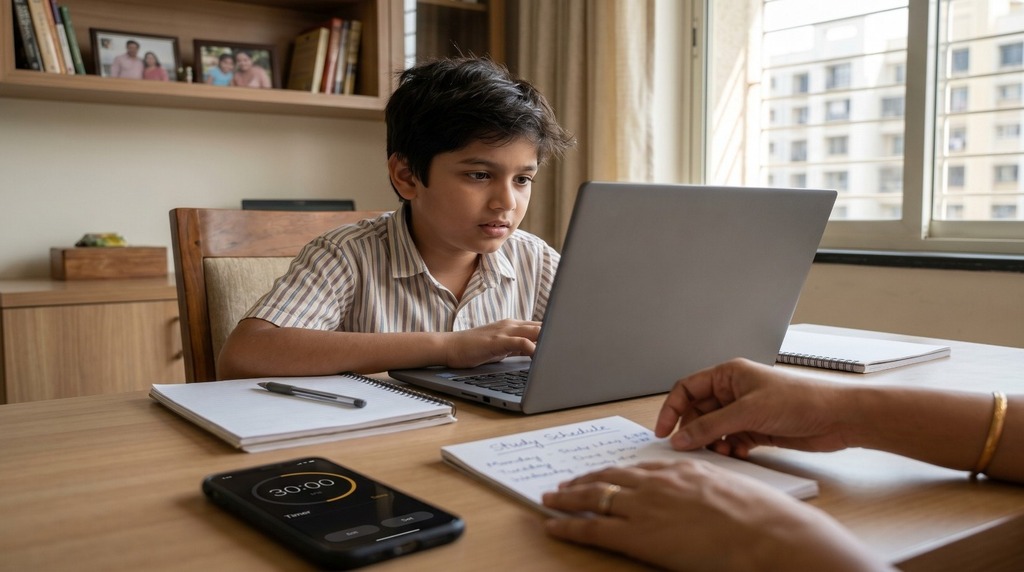
Open your child’s screen time report right now.
Not to punish them. Not to start a fight. Just look at the number.
If you are like most Indian parents, what you see will surprise you. Four hours. Five hours. Sometimes six. And somewhere buried inside that number is the thirty minutes of actual studying your child insists they did.
This is not a discipline problem. This is not a generation problem. And it is definitely not your child’s fault.
It is a design problem, and it is happening in homes across every city, town, and village in India right now.
The screen your child uses for studying is the exact same screen they use for entertainment. The same device, the same browser, the same recommendations engine that knows your child better than you do, and uses that knowledge to keep them watching, scrolling, and playing instead of learning.
Until you change how your child interacts with technology, no amount of rules, timers, or arguments will fix the imbalance. The screen will always win that battle.
Here is how to stop fighting and start designing.
1. Why do children spend more time on Screens Than Studying Today?
The average Indian child between ages 8 and 16 now spends over 4 hours daily on screens, but less than 2 of those hours are spent on anything educational.
This is not laziness. This is neuroscience.
Every app, every video platform, every game your child uses was built by teams of engineers whose single job is to maximise engagement. Infinite scroll, autoplay, achievement badges, personalised recommendations, every feature is designed to eliminate the natural stopping points that used to exist.
A generation ago, a child finished a chapter and closed the book. There was a natural end. Today, the moment one YouTube video finishes, three more begin automatically. The moment one game level ends, the next loads instantly. There is no pause. There is no off-ramp.
Children are not choosing screens over studying. They are being held by screens while studying feels difficult by comparison. The screen offers constant reward. Studying offers a delayed reward. For a developing brain, this is not a fair contest.
2. Screen Time vs Study Time: Where Most Parents Get Confused
Here is the most common mistake Indian parents make: they measure screen time rather than study quality.
Two hours of screen time means nothing on its own.
Two hours of a child passively watching videos and two hours of a child actively building a coding project are both “two hours of screen time.” They produce completely different results. One builds dependency. The other builds capability.
The real question is never “how long was my child on the screen?” The real question is “what was my child actually doing on the screen, and how focused were they while doing it?”
Parents who chase screen-time limits without addressing what happens during that time win small battles but lose the larger war. The child gets off the screen at 8 pm, and has learned nothing.
Study time is not screen time with a notebook nearby. Study time is focused, purposeful, structured engagement with learning content, with everything else blocked out.
3. How Too Much Screen Time Is Affecting Focus and Learning
The impact of unstructured screen time on children’s ability to learn is not a parenting opinion. It is documented and measurable.
Children who spend significant time each day on entertainment-focused screens show reduced ability to sustain attention to tasks that do not provide instant feedback. Reading a textbook, solving a maths problem, writing an essay, all of these require the brain to generate its own motivation and push through discomfort. Screens that provide constant stimulation gradually erode this capacity.
Teachers across India are reporting the same pattern: students who are bright, capable, and curious but cannot sit with a difficult concept for more than a few minutes before reaching for a phone.
The attention span is not broken. It has been trained, by hours of content that rewards switching, scrolling, and skipping, to expect constant novelty. Rebuilding it requires a different environment, not just more rules.
4. Simple Ways Parents Can Create a Healthy Study Routine at Home
These four shifts work, not because they are complicated, but because they change the environment instead of fighting the child:
Separate the study device from the entertainment device. Even if it is the same physical laptop, create a separate browser profile, a separate login, or a separate account specifically for studying. The brain responds to environmental cues. A different login creates a different mental state.
Set a learning intention before every session. Before your child opens the computer, ask one question: “What will you finish today?” Not “how long will you study?”, but what will you complete? This shifts the goal from time-based to outcome-based, which is how real learning works.
Make progress visible every week. Show your child their own learning data, which days they studied, how long they stayed focused, and what they completed. Children who can see their own consistency build intrinsic motivation far more effectively than those who are externally monitored.
Replace restriction with redirection. Instead of saying “no screen time until homework is done,” say “let us set up your study session now, and I will show you what you get to learn today.” One creates resentment. The other creates ownership.
5. How Apni Prerna Helps Indian Parents Get This Balance Right
Every principle above, structured environment, purposeful sessions, visible progress, separated learning space, is built directly into Apni Prerna.
Apni Prerna is a student safety software designed specifically for Indian children and families. It does not rely on your child’s willpower or your ability to enforce rules consistently. It changes the environment itself.
The moment your child logs into an Apni Prerna-powered computer, here is what happens:
Unique student login creates instant accountability. Your child logs in with their own roll number. The session has an identity. Anonymous, aimless browsing is not possible. Before a single website loads, the child is already in learning mode.
Entertainment is removed by design, not by argument. Gaming websites, social media, video streaming platforms, and addictive apps are blocked at the system level before they load. Your child does not need to resist temptation because temptation is not present. The path of least resistance becomes learning automatically.
Every learning session is tracked and reported. Parents receive real session data, not just total screen time, but learning time. Which platforms were used, how long the child stayed focused, and how consistency is developing over weeks. You stop guessing and start having informed, confident conversations with your child about their actual progress.
A personalised student dashboard builds self-awareness. Your child can see their own data, today versus yesterday, this week versus last week. This single feature transforms passive learners into self-directed ones. Children begin to track their own progress and feel proud of their consistency, without anyone standing over them.
POD admins and school leaders get a central overview. For community learning centres, schools, and NGOs, Apni Prerna gives leaders a bird’s-eye view of every student’s session, enabling support and intervention without micromanagement.
A parent from a community POD in Nagpur shared this recently:
Earlier, there was a fight for the screen every night. Now he sits at the table and logs in. I didn’t do anything; the system changed everything.”
Every evening used to be a battle over the screen. Now her son sits down and logs in on his own. She did not change him; the system changed the environment.
That is what Apni Prerna delivers. Not a stricter parent. A smarter environment.
Conclusion
The screen time versus study time battle is not won by taking away screens. It is won by redesigning what screens do when your child is in front of them.
Indian parents are not failing their children by allowing technology. They are navigating a system designed by billion-dollar companies to maximise engagement, without any tools to push back.
Apni Prerna gives parents those tools. Structure, visibility, accountability, and family wellness dashboard are built into the environment, so you do not have to enforce them manually every single day.
Because the right balance between screen time and study time is not something your child achieves through willpower. It is something the right environment automatically creates for them.
Stop the Daily Screen Battle. Start Seeing Real Study Progress.
Give your child a computer environment designed for learning, not distraction.
Want more practical guides on building healthy study habits in the digital age?
Apni Prerna is helping parents turn screen time into real learning.
See how it works
Discover Apni Prerna Structured Digital Learning for Indian Families