


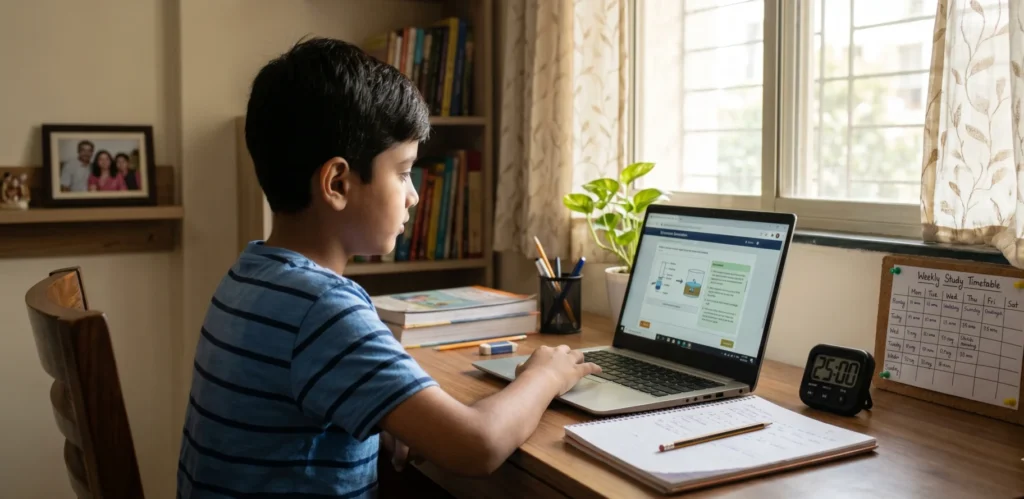
Think about how we teach children to cross the road.
We do not hand them a map of the city and say, “figure it out.”
We walk beside them. We teach them to look left, then right. We practise the habit until it becomes automatic. Only then do we trust them to cross independently.
Digital freedom works the same way.
Yet most Indian children today are handed a device, full internet access, zero preparation, and expected to navigate something far more complex than a road safely, independently, and productively.
The result is predictable. Not because children are irresponsible. But discipline always comes before freedom. In every area of life that matters.
Building Better Digital Habits Before Digital Freedom
Digital habits are not values children are born with. They are behaviours children develop, shaped by the environment around them, the structure they are given, and the patterns they repeat until those patterns become automatic.
The habits that matter most:
Intentional use — opening a device with a purpose, not out of boredom or habit.
Time awareness — understanding that an hour of focused learning and an hour of passive scrolling feel identical in the moment but produce completely different outcomes over time.
Content discernment — developing the ability to distinguish between content that builds something and content that simply fills time.
None of these habits emerges naturally in an unstructured environment. Every single one requires practice, repetition, and the right conditions to form.
The good news: once these habits are established, even partially, digital freedom becomes genuinely safe. The discipline lays the foundation for freedom to stand.
Helping Children Use the Internet With Purpose
Purpose is the single most powerful digital discipline tool available to parents.
A child who opens a device knowing exactly what they are there to accomplish is structurally protected from most of the internet’s worst attention traps. The algorithm cannot compete with a child who already knows what they want.
Build this habit with one question, asked before every session, every day, without exception:
“What will you do today, and how will you know when it is done?”
Simple. Specific. Transformative over time.
A Smarter Way to Guide Children Online
Guidance is not surveillance. This distinction matters enormously.
Surveillance watches for failure. Guidance prepares for success.
A parent who checks browser history every night is surveilling. A parent who sets up a structured learning environment, reviews weekly progress data together with their child, and asks, “What did you build this week?” is guiding.
According to research from India’s Digital Empowerment Foundation, children who receive active parental guidance in digital environments develop responsible internet habits significantly faster than those in either fully restricted or fully unsupervised settings. The middle path, guided structure, produces the best outcomes.
Teaching Kids Balance, Awareness, and Responsible Internet Use
Digital discipline is ultimately about awareness, helping children understand the relationship between their choices online and their life outcomes.
A child who understands that:
- Focused sessions build skills that passive sessions never will
- The internet responds to direction, not just access.
- Their online time is an investment in their future, not just entertainment in the present.
…is a child who can eventually be trusted with digital freedom. Because the discipline came first.
This is exactly what Apni Prerna builds for Indian children, session by session.
Harmful content blocked. Learning tools prioritised. Progress tracked and visible. Individual accountability is built into every login. Parents are informed through honest session reports.
No restriction. Structured preparation for responsible independence.
Conclusion
Digital freedom is the destination. Digital discipline is how children get there safely.
The parents who give their children both structure first and freedom as it is earned are giving them something far more valuable than internet access.
They are giving them the ability to use that access wisely, purposefully, and safely for the rest of their lives.
Apni Prerna helps Indian children build that foundation, one structured session at a time.
Your child deserves digital freedom built on real digital discipline.
Apni Prerna creates that foundation automatically, every session, for every Indian child ready to learn with purpose.
Help Your Child Build Digital Discipline Discover Apni Prerna
Explore More: Preparing Children for the Future of AI Learning
2 thoughts on “Why Children Need Digital Discipline Before Digital Freedom?”
This is such a crucial topic, Varsha! In today’s hyper-connected world, it’s so easy to hand over a device for convenience, but granting digital freedom without first building a foundation of digital discipline can be overwhelming for kids. Teaching them how to set boundaries, recognize online risks, and manage their screen time equips them with the skills they actually need to navigate the internet safely. The idea of gradually earning that freedom through demonstrated responsibility is a fantastic approach for parents to adopt. Thank you for sharing such a practical and timely perspective!
Loved this perspective. Digital freedom becomes meaningful only when it’s supported by good habits.