


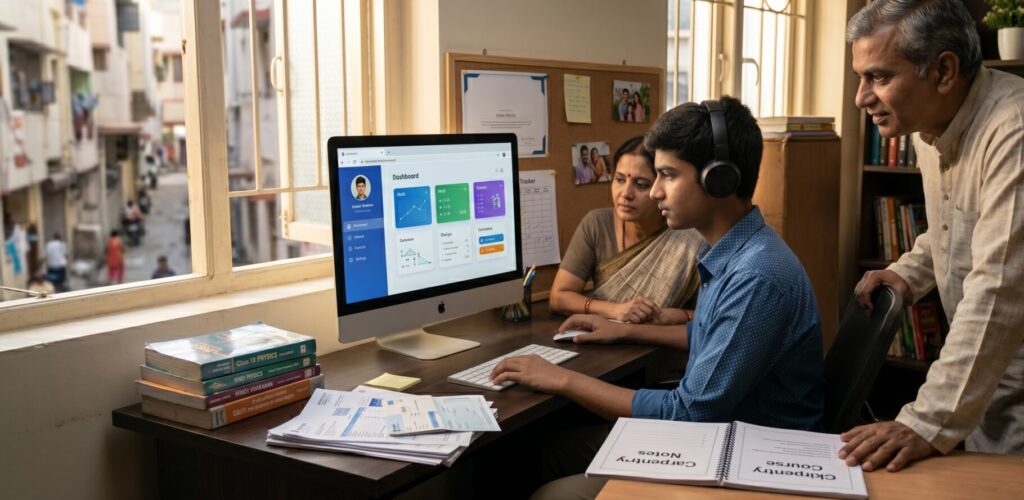
Fast forward ten years.
Two young adults, both 22 years old, both grew up with full internet access from age eight and both spent roughly the same number of hours online throughout their childhood, somewhere between 15,000 and 20,000 hours by most estimates.
One of them can code, communicate confidently, research independently, and navigate digital tools that most of their peers struggle with. They built a portfolio of real skills during those childhood years, one focused session at a time.
The other spent those same hours online, emerging with excellent reflexes in mobile games, an encyclopedic knowledge of entertainment content, and very little to show academically or professionally for nearly two decades of internet access.
Same number of hours. Same internet. Same opportunity.
Entirely different outcomes.
The variable that separated these two futures was decided years earlier, not by talent, not by luck, but by whether their childhood internet time was structured for genuine learning or left entirely unguided.
Your child is living through that decision right now.
1. Internet Access Is Not the Same as Internet Education
Every Indian parent today has given their child something previous generations never had, instant access to the entire world’s knowledge.
But access and education are not the same thing. They have never been the same thing.
A child with internet access can learn to code, build websites, master a second language, and develop genuine digital literacy. The same child, with the same access, can also spend years cycling through entertainment content that builds nothing transferable to their future.
The internet does not choose which path your child takes. It is neutral, vast, and indifferent to outcomes. The structure around how it is used, that is what determines whether internet time becomes internet education.
According to the Ministry of Electronics and Information Technology’s Digital India initiative reports, India now has over 800 million internet users, with children and young people representing one of the fastest-growing segments. The infrastructure for digital education has arrived at an unprecedented scale. What remains uneven is the structure that translates this access into genuine learning outcomes.
2. Why Unstructured Internet Use Rarely Builds a Child’s Future
Here is the uncomfortable truth most parents sense but rarely articulate.
A child given unrestricted internet access with no guidance is not exploring freely toward their best interests. They are following an algorithm that has been engineered by some of the most sophisticated technology companies in the world to maximise their engagement, not their growth.
Every recommendation, every autoplay, and every notification is optimised for one outcome: keeping the child on the platform longer. Whether that time builds their future or simply occupies their present is irrelevant to the algorithm’s design.
UNICEF’s Digital Civility Index research on children’s online experiences across multiple countries, including India, found that children navigating unstructured digital environments without parental guidance or structural support consistently develop weaker digital literacy and online safety awareness than children with guided digital access.
This is not a reason to remove the internet. It is a reason to structure it deliberately, consistently, and with your child’s actual future in mind.
3. What Internet Time That Builds a Real Future Actually Looks Like
Internet time that builds your child’s future has three consistent characteristics. and you can recognise them immediately:
It produces something tangible. Examples include a coding project, a piece of writing, a completed course, or a new skill demonstrated. Internet time that builds a future leaves evidence behind. Internet time that does not build a future leaves only memories of entertainment consumed.
It compounds over time. Each session connects to the last, building progressively on previous learning rather than starting from zero repeatedly. A child constructs genuine capability by learning one coding concept this week and building on it next week. A child who watches unrelated content in every session is not accumulating anything that builds on previous learning.
It happens in a safe, focused environment. Genuine learning requires sustained attention, something that is structurally impossible in an environment filled with notifications, recommendations, and competing entertainment options. Safe internet use for children is not just about protecting them from harmful content. It is about protecting their attention long enough for real learning to occur.
For more detailed guidance on creating internet environments that genuinely build children’s futures, the Apni Pathshala blog offers practical strategies developed specifically for Indian families and learning communities.
4. How Apni Prerna Turns Internet Time Into a Real Foundation for Your Child’s Future
This is exactly what Apni Prerna was built to deliver for Indian children.
Apni Prerna is student safety software that transforms internet access from an unstructured risk into a structured, safe, future-building learning environment, automatically, from the very first login.
Here is how it changes what your child’s internet time actually produces:
Every session begins with identity and purpose. Your child logs in with a unique student roll number, entering each session as a learner with a record, not an anonymous user with infinite, directionless options. This single shift changes the trajectory of every session.
Harmful and distracting content is structurally blocked. Adult content, gaming platforms, social media, and malware are blocked at the system level before they ever load. Your child’s safety online is not dependent on their judgment in a vulnerable moment; it is built into the environment itself.
Only future-building tools are accessible. Educational platforms, coding resources, AI learning assistants like Eklavya, and digital literacy tools work instantly and smoothly. Every session your child spends is focused on building, not drifting.
Progress compounds and becomes visible. Every session generates real learning data: what was studied, how long focus was sustained, and how consistency is building week over week. Students see their growth. Parents receive honest reports. The internet time that once disappeared into uncertainty is now a visible, trackable record of genuine development.
This structure already runs across 30+ learning communities in India, from tribal villages in Nagaland to urban centres in Dharavi, proving that safe, future-building internet use is achievable at scale, not just in theory.
A father from a community POD in Bihar described what shifted for his daughter:
Before, it felt like the internet was just a way to pass time. Now he sees his daughter learning to code, building real projects. This, he says, is the future.
That is the difference structure makes. That is what ten years from now should look like for every Indian child online today.
Conclusion
Your child is using the internet right now, today, this evening, every day.
The question is not whether that internet time is happening. It already is, and it will continue to.
The question that actually matters is what that time is building, ten years, fifteen years, or twenty years from now, when those thousands of childhood hours either show up as genuine skills, confidence, and opportunity or simply disappear into memories of content consumed.
That outcome is not determined by talent or luck. It is determined by structure, by whether your child’s internet time today is guided toward building something real.
Apni Prerna provides that structure. Every session. Every day. Building toward a future that your child’s internet time can genuinely be proud of.
Ten years from now, your child’s internet time will have either built something real or simply passed.
More insights on safe, meaningful internet use for Indian children: Click Here
Apni Prerna makes sure it builds something real, starting today.
10 thoughts on “Your Child Spends Hours Online Every Day: Ten Years From Now, What Will That Time Have Built?”
Sad, reality is that even after study for last 10 years he don’t know how to open and use computer.
Thank you for sharing this. This is exactly why guided digital learning matters, children should not just study, they should learn to use technology confidently.
A great reminder that every click, search, and screen session is shaping the future.
Thank you. Truly, every click shapes how children learn and grow.
nice blog
Thank you! Glad you found it useful.
yes, every parent must use tool like this one because tracking child progress help you to grow your child skill and potential.
Thank you for sharing. True, tracking a child’s progress helps parents understand their skills better and support their growth in the right way.
This article shifts the conversation from screen time limits to screen time value.
This is such a powerful question to ask. Thinking about what kids are actually building with their screen time changes the whole perspective on the hours they spend online. When guiding students in the computer lab to move beyond just clicking around and actually start problem-solving or creating, it’s amazing to see how those hours transform into real, practical skills. Imagining my own little one ten years from now, I definitely want their digital habits to reflect curiosity and hands-on creation rather than just endless consumption. This article is a fantastic reminder to focus on the long-term value of technology!