


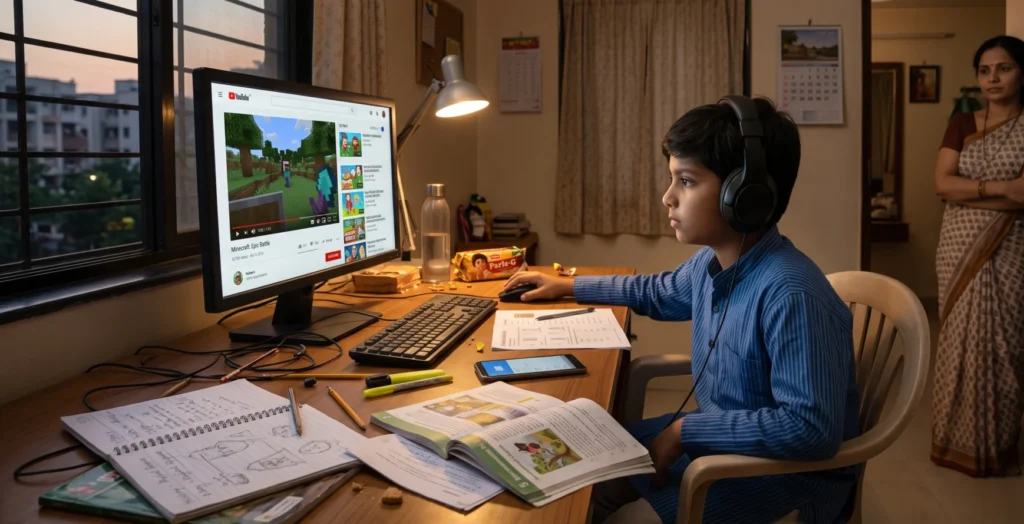
You told yourself it was just 10 minutes. That was an hour ago.
And your kid is still watching YouTube, headsets on and totally uncontactable. You know deep down inside that an alarm is being set off somewhere.
You’re not overreacting here. Your gut feeling deserves some consideration.
YouTube actually has a lot of quality stuff for kids, from science shows to stories, crafts, and other educational programs. No argument there. But the same platform that teaches your child about space can also quietly become something they can’t go a day without. And the transition from “useful” to “dependent” happens slowly, without anyone really noticing.
Is It Really Addiction?
Let’s be careful with that word. Addiction is serious, and most children aren’t there. But dependency? That’s real, and it’s far more common than parents realise.
What makes YouTube different from other forms of screen time is that it’s genuinely useful at times. Kids use it for school projects, drawing tutorials, science experiments. So when a child is on it constantly, it doesn’t always look like a problem. It can look like curiosity. That’s exactly what makes it easy to miss.
Signs Your Child Might Be Dependent on YouTube
1. They Struggle When the Screen Goes Off
The child is more than just a little disappointed when YouTube shuts down. They blow it up emotionally, argue at times, or stay upset for prolonged hours; then it demands your attention. Frustration from time to time is normal for children. However, if the pitching is constant and exaggerated, it signifies that the dependency runs deeper than just enjoying a video
2. Other Activities Have Taken a Back Seat
Think about what your child enjoyed before YouTube became a fixture. Drawing, playing outside, reading, board games. If those things have gradually faded and screens have filled the gap, that is worth noticing. It is not about removing YouTube entirely; it is about ensuring it has not quietly replaced what matters.
3. Time Disappears Every Single Time
Every time your child sits to watch, a few minutes pass and an hour passes without them realising. This is largely by design; YouTube’s autoplay feature removes any natural stopping point, and the algorithm is built to keep viewers watching. Children are particularly vulnerable to this. If your child consistently loses track of time on YouTube, it is less about self-control and more about how the platform works.
4. YouTube Has Spilt Into the Rest of Their Day
Their conversations revolve around YouTubers. They re-enact videos. They want to film everything they do. Some of this is completely normal; children are influenced by what they watch. But when YouTube becomes the running theme of their day even when the screen is off, it has taken up more space than is healthy.
5. Their Sleep Has Been Affected
Parents often do not notice this for some time. Your children are always finding ways to watch YouTube; it can be midnight or any odd time, like when they think no one is looking late at night, early in the morning, during moments they know they should not be on a device. If your child appears consistently tired or is reaching for a screen the moment they wake up, then it needs your attention
6. Their Mood Is Tied to Screen Access
Content and settled when YouTube is available, irritable and restless without it. If your child’s emotional state seems consistently linked to whether they have access to a screen, that pattern deserves attention. Children have big feelings, but their baseline mood should not depend on a device.
Why YouTube Specifically?
Not all screen time is the same, and YouTube stands apart for a few reasons.
Autoplay is one of the biggest factors. The moment one video ends, another begins, no decision required. Combined with an algorithm that learns exactly what keeps your child engaged, it creates an environment that is genuinely difficult to step away from.
There is also the impact on attention span. Excessive use of YouTube, particularly YouTube Shorts, gets the brain used to fast, constant stimulation. Over time, slower activities like reading, outdoor play, or even conversation can start to feel less engaging or boring. That is one of the quieter effects that parents often notice before they connect it to screen time.
What Can Parents Actually Do?
1. See what’s actually happening
Most parents are shocked to learn how much time their kids spend on YouTube and what content they view there. What you don’t know about your kids, you cannot control. Apni Prerna provides a real-time activity feed to parents, showing them the activities on their kids’ screens, the sites they’ve visited, and which ones are being blocked.
2. Block what doesn’t belong
Unrestricted YouTube access means the algorithm decides what plays next. Apni Prerna lets you block distracting and inappropriate content, set an allow-only mode, and make sure your child’s screen time stays within the boundaries you’ve actually chosen, not the ones YouTube chooses for them.
3. Set a schedule and stick to it
The daily argument about screen time is exhausting for everyone. With Apni Prerna, you set the schedule once: study hours, dinner, bedtime and the platform enforces it automatically. No negotiations. No “just one more video.” The rules you set actually hold.
4. Read the weekly reports
Apni Prerna sends parents weekly and monthly activity reports with clear, simple breakdowns of screen time, browsing patterns, blocked attempts, and trends over time. When you can see the data, you can have real conversations with your child based on facts, not arguments.
5. Be honest about your own screen habits
Children notice everything. If a phone is always in your hand, it becomes very hard to explain why YouTube has limits for them but not for you. The households where this works best are the ones where screen boundaries apply to everyone, not just the kids.
6. Replace the habit, don’t just remove it
Boredom isn’t the enemy; it’s often where creativity begins. But kids usually need a nudge. Pick up a game you loved growing up. Sit with them and do something hands-on for ten minutes. YouTube became a habit through repeated access. It can be replaced the same way, just with something better.
Conclusion
YouTube isn’t going away any time soon, and that’s okay. It wasn’t meant to disappear anyway.
The parents who will deal with it successfully are not those who will be frustrated and just rip them from their hands. Those parents are the ones who stay well informed, set limits, and have the right tools.
Apni Prerna was built for exactly this. It’s a parental control and monitoring tool that gives you visibility into your child’s digital day, real-time activity tracking, content filtering, screen time schedules, and weekly reports, all from your phone, without hovering over their shoulder.
It’s already trusted by 100+ organisations across India, and right now it’s free for the first 100 parents.
If something about your child’s YouTube use has been sitting uneasily with you, that feeling is worth acting on. Get started with Apni Prerna for free.
1 thought on “Is Your Child Addicted to YouTube?”
This article encourages parents to look beyond the symptoms and focus on long-term digital well-being.