


You’re not a bad parent for handing your child a phone. You’re a tired one. And there’s a difference.
Every parent today is quietly navigating the same battle: screens that are impossible to avoid, children who want them constantly, and no clear rulebook for what’s actually okay. If you’ve been struggling with this, you’re not alone, and you’re not failing.
Managing screen time is one of those parenting challenges nobody really prepares for, and yet almost every parent is quietly dealing with it.
There is no universal rule that works for every child. Between work, school runs, and everything else life throws at you, it is far easier to hand over a device than to have an argument. And honestly, most parents have been there.
It starts innocently enough. A cartoon to keep the kids busy while dinner is being made. A quick game during a car ride. Before long, the tablet becomes the first thing they reach for in the morning and the last thing they put down at night.
But here is the thing: small, consistent boundaries today make a much bigger difference than one thinks. This blog breaks it down in a way that is realistic, practical, and actually doable and serves as a parental guide:
Why Screen Time is a Bigger Problem Than Most Parents Realise
Today, a kid in every household spends twice the time recommended by paediatricians and major health organisations. Children today are alarmingly engrossed in their devices and digital media due to social interaction, academic requirements, and entertainment preferences, etc.
According to recent findings, kids today spend double the time, which can affect a child’s cognitive abilities (intelligence), social interactions, and psychomotor development. It can also cause short-term effects like sleep disruption, reduced physical activity, and attention issues(ADHD) that affect a child’s overall development during their growing years. In the long term, a child can develop social anxiety and mental health conditions.
According to WHO‘s new guideline – “Very limited daily screen time recommended for children under 5.” The organisation recommends That Children under the age of five use digital devices for no more than an hour each day, and children under the age of two should not use them at all.
The World Health Organisation has clear statements regarding children and screen time. Children under two should not be exposed to screens at all, except for video calls with family.
Children between the ages of two and five should have a daily limit of an hour, and that hour should count toward digital learning, meaning good-quality, age-appropriate content.
For children aged six and above, the focus shifts to consistency, ensuring screens do not eat into sleep, physical activity, or family time. These are not a strict rulebook but guidelines for both new and experienced parents. Every child is different. Hence, these guidelines help parents have a solid, research-backed starting point to work from. Children above five having screen time is not all bad. But there should be a balance for their betterment and future health conditions.
Every child is unique; hence, there is no hard-and-fast rule when it comes to parenting. However, every child deserves real experiences like messy ones, outdoor ones, boring ones. The kind screens simply cannot replicate. Here are a few things that might help find that balance.
6 Practical Ways to Manage Your Child’s Screen Time That Actually Work
1. Set Clear Boundaries and Follow Through
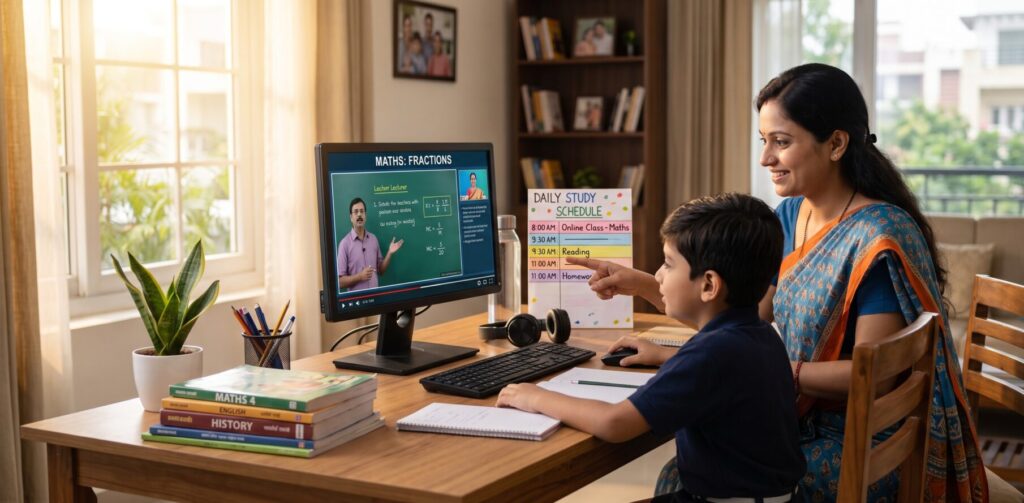
Children do not need fewer rules around screens; they need clearer ones. As a parent, it can be hard to keep children away from screens and devices, but it’s an important step to take for their kids. Parents can include children and decide as a family which times are screen-free, such as during meals, the hour before bed, weekend mornings, etc. It does not have to be complicated. A simple, consistent routine tells children what to expect and when to expect. This also gives children a sense of ownership, as they’re contributing to the decision; hence, they’re more likely to follow it.
2. Make Screens Something to Look Forward To and Not a Habit
When screens are always available easily, they lose their place. Tying screen time to the completion of homework, outdoor play, or chores shifts the dynamic entirely. Children start to see it as something earned rather than something owed, and that one shift changes a lot.
3. What They Watch Matters as Much as How Long
An hour of educational content is different from an hour of mindless scrolling. Pay attention to what is actually on the screen, not just the duration. Look for content that sparks curiosity, encourages creativity, or teaches something. Co-viewing when possible also helps; it turns screen time into connection time.
4. Your Habits Are Louder Than Your Rules
Children notice everything. If parents are constantly on devices during dinner, conversations, or family time, the message gets through, and kids follow it, regardless of what is being said. Kids see and follow. Modelling the behaviour you want to see is not just good advice; it is the most effective parenting tool out there.
5. Use Apni Prerna to Make Screen Limits Automatic
Technology is getting more helpful for parents. There are countless useful tools like Apni Prerna that allow parents to set limits on how much time their children spend on their devices, filter certain types of content they view, and monitor how much time their children spend on their devices without being a ‘helicopter parent’. Apni Prerna is a parental control and child monitoring tool trusted by 100+ organisations across India. It runs quietly in the background on your child’s device, giving you complete visibility and control without you having to hover over their shoulder all day.
Here’s what Apni Prerna actually does-
- Content Filtering and Safe Browsing — Block harmful websites, adult content, gaming sites, and distracting apps. You choose what your child can access and not the platform’s algorithm.
- Real-Time Activity Monitoring — See exactly which websites your child is visiting, how long they’re spending on each one, and what’s being blocked, all from your phone, in real time.
- Weekly Reports and Alerts — Get clear weekly and monthly summaries of your child’s screen activity, blocked attempts, and usage trends. Know the facts before you have the conversation.
- Repeated Attempt Alerts — If your child keeps trying to access a blocked site, you’ll know immediately.
It works on Windows and Linux devices and takes just three steps to set up: (i) Create an account, (ii) Install on your child’s device, and (iii)You’re done.
Parents can set the tools up once and make small adjustments as the child grows. These tools provide parents with at least some relief from the responsibility of fully monitoring their child’s device usage.
6. Fill Their Time Before They Fill It With Screens
The easiest way to reduce screen time would be to have no screen time. Children do not get attached to the screen when they have other things to do, such as parents taking children to the park, sitting with a colouring book, reading aloud, playing ball in the garden, or doing chores together. Sometimes the child gets interested in the screen because there’s nothing else to do. Tire them out. A child who has spent the afternoon running around or lost in a story is far less interested in staring at a screen by evening. Kids love spending time together more than spending time on devices.
Conclusion: The Right Tools Make This So Much Easier
Parenting in the digital age is genuinely hard. Letting your child use a phone or tablet to get through the day does not make you a bad parent but a real one.
But here’s what separates parents who feel in control from those who feel constantly reactive: the ones who feel in control have systems. They’re not manually policing every device every day. They’ve set boundaries once, put the right tools in place, and let those tools do the heavy lifting.
Apni Prerna is that tool. It blocks what doesn’t belong, schedules screen time automatically, monitors activity in real time, and sends you weekly reports, so you always know what’s happening without making it a daily fight.
1 thought on “How to Manage Screen Time for Children in 2026, A Practical Guide for Indian Parents”
Well written! Consistent routines can make digital learning healthier and more productive.