


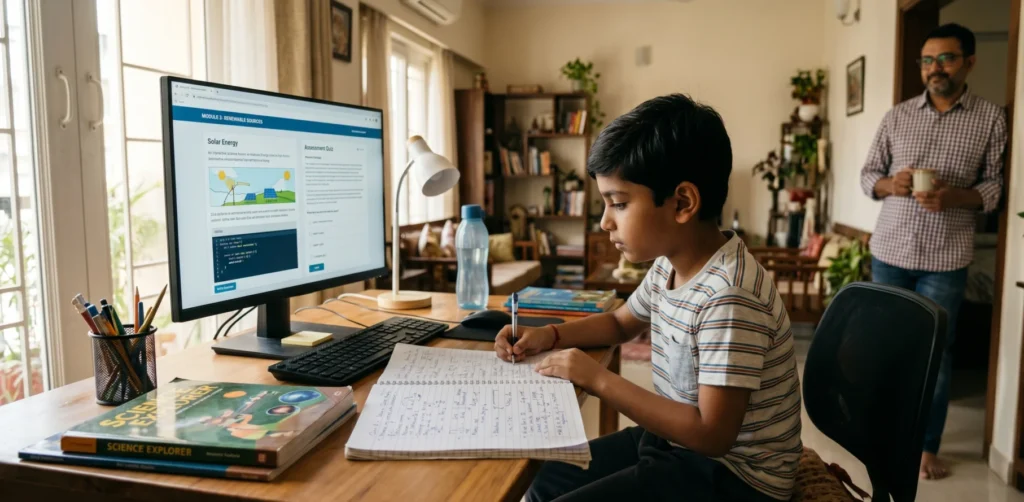
You cannot tell productive screen time from wasted screen time just by looking at your child.
Both look identical from across the room. Focused eyes. Quiet concentration. Fingers on the keyboard or screen.
But one is building your child’s future. The other is simply passing time.
The only way to know the difference is to ask the right questions not guess based on appearances.
Here is the checklist. Go through it honestly. It takes five minutes and tells you more than weeks of watching from the doorway ever could.
The Productive Screen Time Checklist
Answer yes or no to each question, based on your child’s last study session.
☐ Did your child know what they were going to do before they opened the screen?
A clear goal beforehand is the single strongest predictor of productive screen time. If the answer was “let’s see what comes up,” that is passive drift, not purposeful learning.
☐ Can your child explain one specific thing they learned, in their own words?
Not “I studied science.” Something specific, “photosynthesis converts sunlight into energy” or “I learned how to use a for-loop in coding.” If they cannot articulate anything specific, retention likely did not happen, regardless of how long they were on screen.
☐ Was the device used only for the intended purpose during the session?
If your child switched between homework and entertainment multiple times, the session was fragmented. Fragmented attention produces dramatically lower retention than sustained focus, even if total time looks the same.
☐ Did your child finish the session with something to show for it?
A completed exercise, a written paragraph, a coding project, a solved problem set. Productive screen time leaves evidence. Passive screen time leaves only memories of content consumed.
☐ Was your child able to maintain focus without you checking on them?
If your child only stayed on task because you walked past every ten minutes, the session was externally managed, not internally productive. Genuine engagement does not require constant supervision.
Scoring:
4-5 Yes answers — Genuinely productive session. Keep doing what you are doing.
2-3 Yes answers — Mixed session. Some learning happened, but the environment needs adjustment.
0-1 Yes answers — This was largely passive screen time, regardless of how educational the content appeared.
1. Why “Educational Content” Does Not Automatically Mean Productive Learning
Here is the trap most well-meaning Indian parents fall into.
You see your child on an educational platform. The content is legitimate. The app is reputable. So you assume the time is productive.
But productive screen time is not determined by what content is available, it is determined by how actively the child engages with it.
According to research published by India’s National Council of Educational Research and Training (NCERT), the presence of educational content alone does not predict learning outcomes; structured engagement, active participation, and regular assessment of understanding are the actual drivers of retention and skill development.
A child passively watching an excellent science video for 45 minutes may retain less than a child actively practising one coding exercise for 15 minutes. Quality of content matters less than most parents assume. Quality of engagement matters far more.
2. The Three Hidden Signs Your Child’s Screen Time Is Working
Beyond the checklist above, watch for these three subtle but reliable signs that learning is genuinely happening:
They ask questions afterward, unprompted. A child who genuinely learned something often comes back with a follow-up question, sometimes hours later. “Why does the moon look different shapes?” after a science session indicates the content actually activated curiosity and thinking, not just passive viewing.
They want to show you something specific. Productive learning produces pride. A child who built or learned something real often wants to demonstrate it,“Look what I made” or “Watch me do this.” Passive screen time rarely produces this instinct, because there is nothing specific to show.
Their consistency builds without resistance. Productive learning sessions, even when challenging, tend to be returned to more willingly over time because the child experiences genuine progress. If every session requires the same battle to begin, the screen time is likely not delivering the sense of accomplishment that sustains motivation.
For more detailed guidance on recognising and building productive digital learning habits, the Apni Pathshala blog offers practical, India-specific frameworks for parents navigating this exact challenge.
3. What to Do If Your Child’s Screen Time Failed the Checklist
If your child scored low on the checklist above, here is what actually helps — starting today:
Add a pre-session purpose. Before the screen turns on, ask one question: “What will you finish today?” This thirty-second habit alone moves many sessions from passive to purposeful.
Reduce the number of available tabs and apps. Every additional option is a distraction the session must compete against. Fewer options mean more focused engagement on the content that matters.
Introduce a brief end-of-session recall. One question — “What is one new thing you learned?”, forces the kind of active recall that converts passive exposure into genuine retention.
Remove entertainment access during study windows. This is the single highest-impact change available. When entertainment is not an option, the brain commits fully to whatever remains, which, structured correctly, is learning.
According to a study referenced by India’s Digital Empowerment Foundation, structured digital learning environments with limited distraction access show measurably higher engagement and task completion rates among Indian students compared to unrestricted environments, reinforcing that environmental design, not content alone, determines productive outcomes.
4. How Apni Prerna Makes Every Session Score Higher on This Checklist
Here is the most reassuring part of this entire conversation.
You do not have to manually run this checklist every single evening, asking yourself whether today’s session was productive.
Apni Prerna builds the conditions for a high-scoring session into the environment itself, automatically, every time your child logs in.
Purpose is built into login. Every student enters with a unique roll number, creating session identity and accountability before a single page loads. The first checklist item, having a clear purpose, is structurally supported from the start.
Distractions are removed entirely. Gaming, social media, and entertainment platforms are blocked at system level. The “did they stay on task without checking” question becomes far more likely to score yes, because the environment removes the temptation to drift in the first place.
Real learning tools replace passive content streams. Coding platforms, structured educational resources, and AI learning assistants encourage active engagement rather than passive consumption, directly supporting genuine retention and the ability to explain what was learned.
Progress is automatically visible. Every session generates honest data focused time, platforms accessed, consistency tracked. Parents do not need to run a checklist manually. The data answers the question directly, every single week.
A mother from a learning POD in Madhya Pradesh shared what changed for her family:
Before, she had no way to know if screen time was worthwhile. Now she checks the dashboard, everything is clear. Her son is proud to show his progress too.
Conclusion
Not all screen time is created equal and now you have a simple way to tell the difference.
The checklist above takes five minutes. The patterns it reveals can reshape how your family approaches digital learning entirely, moving from anxious guessing to confident, evidence-based parenting decisions.
Productive screen time is not about finding the perfect app or enforcing the strictest rules. It is about building an environment where purposeful learning becomes the natural outcome of every session, checklist or not.
Apni Prerna builds that environment automatically, so most evenings, you will not need the checklist at all. You will simply know.
Stop guessing whether screen time is productive. Start knowing, automatically, every session.
Help your child turn screen time into better study habits: Click here
Apni Prerna builds the conditions for productive learning into the environment itself.
5 thoughts on “Is Your Child’s Screen Time Actually Productive?”
A valuable perspective on turning screen time into growth time.
perfect blog
depends, their is no guarnty if child using pc for 2 hr is not worthy or 2nd using it for less time is doing something productive.
Varsha, this is such a refreshing perspective! Seeing kids light up in the classroom when they finally figure out a digital puzzle or master a new tool firsthand really proves that screen time doesn’t have to be a negative thing. It truly comes down to shifting their habits from passive scrolling to active creation. A great piece of advice for anyone navigating this is to try sitting down and asking the kids to teach you what they are doing or building on the screen it completely changes the dynamic and makes them feel proud of their skills. Thinking about this with my own baby at home makes me excited to eventually guide those early tech interactions toward genuine learning rather than just entertainment. Great read!
yes…. every parent face this problem