


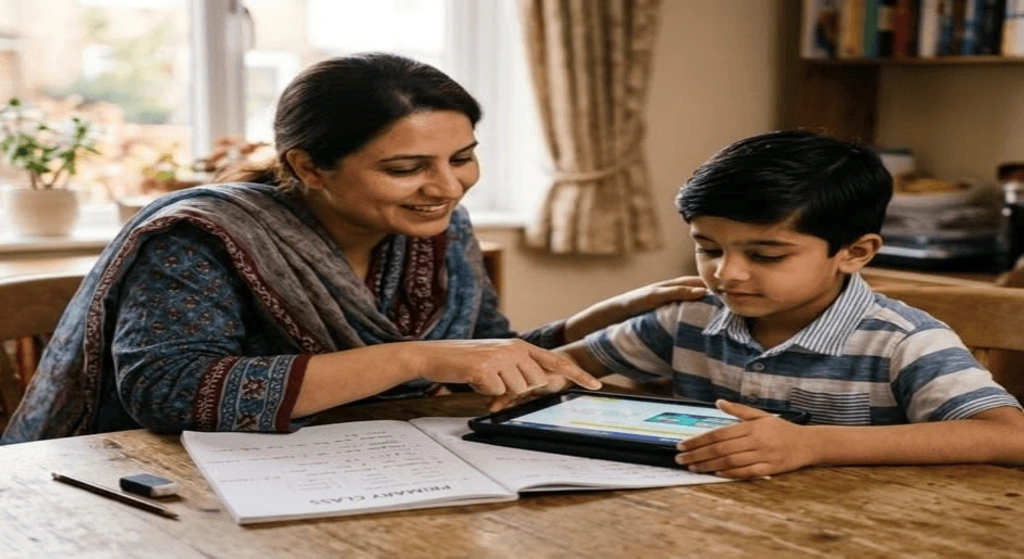
Let us be honest for a moment.
Nobody prepared you for this.
Your parents raised you without smartphones. Your teachers taught you without YouTube. And now you are raising a child whose entire education, homework, revision, creative projects, and skill-building happen on a screen.
You are navigating something genuinely new. And you are doing it without a map.
This is that map.
1. The Digital Age Changed Parenting But Nobody Told Parents
Here is the shift most families miss.
A generation ago, parents got their children to school, ensured they did their homework, and showed up to PTMs. The school handled learning. The home handled values.
Today? The boundary has dissolved completely.
Learning happens at home, on a laptop, a tablet, or a shared computer. The school provides content. But what about the environment in which that content is absorbed, processed, and retained? That is entirely in your hands.
Digital parenting is not about managing screen time. It is about managing the quality of the environment in which your child learns, grows, and develops digital habits that will follow them for life.
That is a bigger responsibility than any previous generation of parents carried. And it deserves to be taken seriously.
2. The Screen Is Now the Classroom: Here Is What That Actually Means
When a screen is a classroom, everything about it matters.
What loads first? What is blocked? What the child is recommended next is Whether the session has a purpose or not. Whether the child is accountable or anonymous.
A physical classroom has walls, rules, a teacher, a bell, and a structured sequence of learning. It was designed, deliberately, for learning to happen inside it.
Most children’s home screens have none of these things.
According to UNICEF’s research on children in the digital world, children who learn in unstructured digital environments consistently show lower retention, weaker focus, and more problematic screen habits than those with guided, structured digital access.
The lesson is simple: if the screen is the classroom, it needs to be designed like one.
3. The Three Things Every Child Actually Needs to Focus Online
Forget the apps. Forget the platforms. Forget the screen time limits.
Three things, and only three, determine whether your child actually learns during a digital session:
A clear purpose before they open the screen. Not a rule. Not a timer. A question: “What will you finish today?” That question takes 20 seconds. It changes the entire session.
An environment with no competing options. A child who can study or game is making that choice every 8 minutes. A child whose screen only offers learning makes no choice at all. Learning simply happens.
Visible progress they can feel proud of. Children do not need prizes. They need to see themselves growing. A simple weekly learning record, showing what they studied and how consistently they showed up, builds more motivation than any reward chart ever could.
That is it. Three things. No complicated system required.
4. Four Digital Parenting Habits That Take Under Five Minutes Each
These work because they are small. Small habits stack. Complicated systems collapse.
The Before-Screen Question (30 seconds): Before every session, ask one thing: “What’s the plan today?” No plan, no screen. It is that simple.
The Weekly Learning Review (5 minutes, Sunday evening) Sit with your child. Look at their learning data together. Not to judge, to celebrate. “You studied four days this week. That is real.”
The After-Screen Debrief (2 minutes) One question after every session: “What is one thing you learned today that you did not know this morning?” If they cannot answer, the session was consumption, not learning. Now you both know.
The Environment Audit (once this week): open your child’s study device. Count how many non-educational things are one click away. Gaming. Social media. Video streaming. Each one is competing with every lesson. Remove them from the study environment. Not from life, from the study environment.
You can find more practical digital parenting strategies written for Indian families at the Apni Pathshala blog, updated regularly with real insights from learning communities across India.
5. The Tool That Makes All of This Automatic
Here is the honest truth about habits and systems.
Habits require daily energy. Systems run without it.
You can implement every tip above through willpower and consistency, and some days you will. But some days you will be exhausted, distracted, or simply not there.
Apni Prerna is the system that runs on the days you cannot.
It is student safety software built specifically for Indian children, and it puts every principle in this article on autopilot:
The pre-screen purpose is built in through a unique student roll number login. Every session has an identity before it begins.
The distraction-free environment, built in through system-level content blocking. Gaming, social media, and entertainment simply do not exist in this space.
Personal learning dashboards and real session reports build in visible progress. Students see their data. Parents receive honest weekly summaries. No guessing. No assumptions.
According to research from the Journal of Educational Psychology, students in structured, low-distraction digital learning environments show up to 40% improvement in task completion and knowledge retention compared to those in unstructured settings.
Apni Prerna creates that structured environment across 30+ community learning centres in India, from Nagaland to Maharashtra to Kerala, for every student who deserves a digital classroom that was actually built for learning.
Conclusion
Digital parenting is hard because nobody designed the internet for children.
But you do not have to fight the internet alone.
The right habits, small, consistent, and built into daily life, change what your child builds from their screen time. The right system makes those habits automatic on days when you do not have the energy to enforce them manually.
That is the new parenting playbook. Simple habits. Smart systems. Children who actually learn.
You bring the habits. Apni Prerna brings the system. Together, your child gets a digital learning environment that actually works.
Help your child use technology for real growth, not just passive scrolling. Click Now
Explore Apni Prerna Smart Digital Learning for Indian Families