
Introduction
What if I told you that giving computers to classrooms isn’t enough? Some of the learning centers we started barely survived, waiting for the next donation to keep their doors open, but why?
As someone who writes about Apni Pathshala’s journey on blogs, I recently had an eye-opening conversation with Sagar Tiwari, the CEO of Apni Pathshala, about something called MAHES. No, MAHES isn’t a person; it could become the backbone of how we support digital learning centers, or what we call PODs.
Today, I’m taking you inside that conversation. We’ll explore why mentorship matters more than hardware, what makes a learning center truly self-sustaining, and how one framework is changing everything.
Ready to meet MAHES?
Chalo Seekhe!
The Future of MAHES in Apni Pathshala

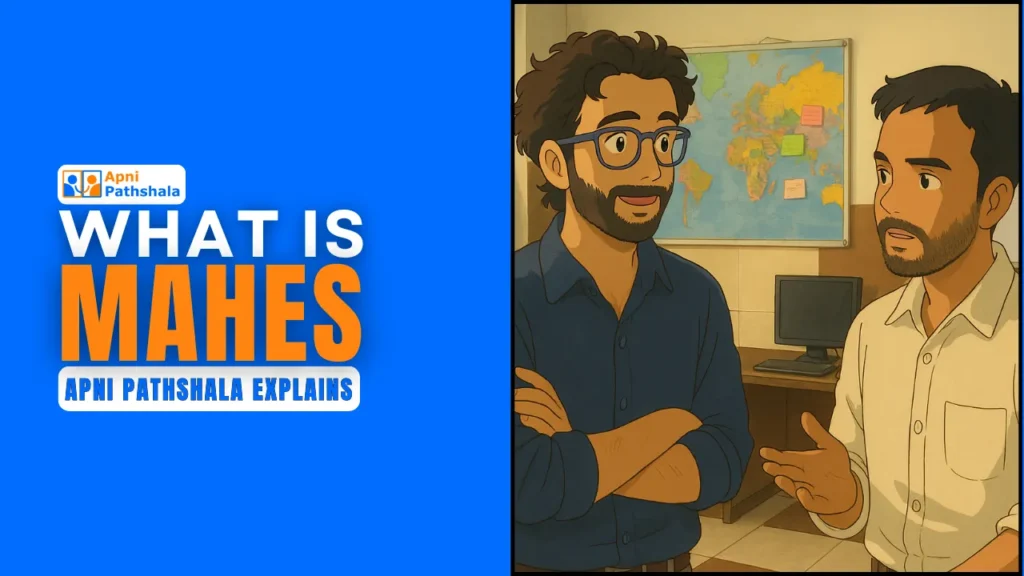
I walked into Sagar’s office expecting a quick chat. Instead, I found myself in what looked like a strategy war room. Sagar stood before a massive whiteboard, marker in hand, completely absorbed.
“What are you doing?” I interrupted.
He turned with a smile. Ashish, I am preparing MAHES for our PODs (digital learning centers).
With confusion, I asked, “Who is MAHES? Why are you planning so much for one person?”
“He’s not a guy. It’s an idea. An idea that could change how we support PODs.”
Now I was hooked. “What idea?”
He set down his marker. “Ashish, I’ll answer all your questions, one by one. Let’s start with the basics.”
What Is MAHES?

“MAHES stands for Mentorship, Autonomy, Hardware, Exposure, and Software. These are the five supports we’re planning to provide PODs.”
I raised my hand like a confused student. “Wait, wait. Why mentor PODs? They already know how to run classes. Isn’t that enough?”
He shook his head firmly. “No!”
“When we started, we were just giving computers to classrooms without any instruction. You know what happened? Some PODs closed. Others are barely surviving, waiting for external donations or funds just to stay afloat.”
That hit hard. “So you’re saying Mentorship and Autonomy can change this?”
“Exactly. Let me break it down for you.”
M – Mentorship: Learning from 100+ PODs
He smiled and explained what MAHES stood for and why it was created.
“We’ve opened more than 100 PODs, right? And we communicate with each one like they’re special, because they are. So we know why PODs succeed, why they fail, and what mistakes to avoid.”
He paused. “It’s not that we’re geniuses. We have data from over 100 PODs. We’ve seen the patterns.”
“So what did you learn?”
“PODs, whether they’re run by NGOs, schools, or individuals, need guidance to become self-sustaining classrooms.”
A – Autonomy: Self-Sustaining Without External Support
He leaned forward, emphasizing his point.
“We’ve always tried to create learning spaces that never depend on external support. That’s what we call autonomy. Remember, all our PODs are different. They operate differently, have different needs, face different challenges.”
“But we have to prepare them for self-sustainability while supporting their individuality. And autonomy is only possible if someone guides them properly.”
I nodded slowly. “Okay, I get it now. But I think that should be enough. Why go further with HES?”

H – Hardware: Apna PC and more
Sagar smiled again. “Listen, have we given computers freely?”
“No, we’ve given them on lease.”
“But we don’t charge any money, right?”
“Yeah, but that’s because their cooperation is their payment. We’re creating a community. We need as many people as possible to reach more students.”
He pointed at me. “Exactly! We give Apna PC, the hardware, to PODs on lease with no cost because their cooperation IS their payment. That’s how we build community.”
E – Exposure: Making PODs Visible
“You forgot Exposure,” I added with a grin.
He laughed. “Yes! We want PODs not to depend on external factors to survive. They need as much exposure as they can get. We feature them on our social media, in our sessions, and even in blogs. We make sure all PODs get enough visibility to be known individually.”
S – Software: Safety and Exploration of Potentials
“But that’s not everything a community needs,” he continued. “They need security, too.”
He moved back to the whiteboard. “That’s where our Software comes in. We’re creating software that supports PODs and teachers. Parents can see their child’s potential. Plus, we have Prodigy, a safety net for children through our Student Safety Software.”
The Grand Reveal
Just as we wrapped up, our core team walked in, curious about our discussion. They probably thought we were playing some word game.
That’s when Sagar shouted with a huge grin, “Hello guys, meet MAHES!”
And just like that, the idea had a name.
Breaking Down MAHES
Visual Breakdown: Key Points from the Conversation
| Key Aspect | Description | Why It Matters |
| Mentorship | Guidance for each POD to help them become self-sustaining. | Without mentorship, PODs lack direction and may not reach their full potential. |
| Autonomy | Encouraging PODs to become independent, without relying on external support. | Autonomy ensures long-term sustainability and reduces dependency. |
| Exposure | Showcasing PODs to a wider audience through media, blogs, and social channels. | Exposure opens doors to new opportunities, partnerships, and recognition. |
| Hardware | Offering quality hardware support, such as Apna PC, to PODs through no-cost leases. | High-quality resources help PODs run efficiently and provide the best for students. |
| Software | Tools to support teachers, PODs, and parents, including safety software for students. | These tools ensure smooth operations and safeguard students. |
Conclusion
The future of learning, especially in rural and underserved areas, depends on creating environments where education is accessible, sustainable, and scalable. MAHES provides the structure and support for these environments to flourish.
This isn’t just about computers or lessons; it’s about giving communities the tools to empower their own future. By focusing on mentorship, autonomy, exposure, and the right resources, we can create classrooms that thrive no matter where they are.
The next step? Join us in making MAHES a reality for all PODs, and help us reach every corner of India. Together, we can change the future of education.
If you’re inspired, don’t forget to share this post with others who might benefit from learning about MAHES and its impact.
Want to be a POD and enjoy MEHES benefits? Check out this blog!
Interested in Apna PC? There’s a blog for that, too!

One Response
This is some quantum physics level strategy. Like how do you even think about such weird name at the first place.