

Introduction
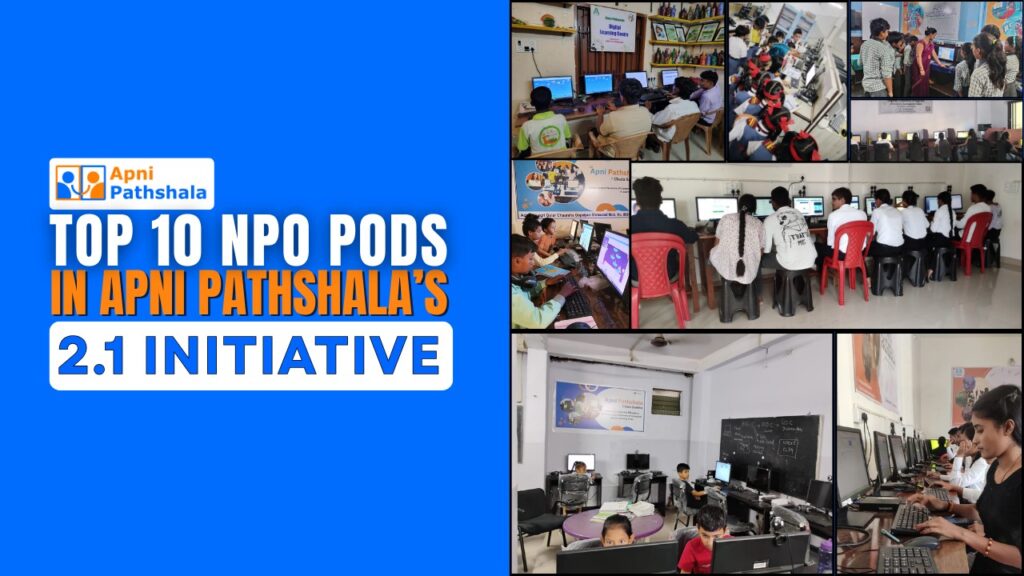
Across India, something beautiful is happening inside small rooms filled with just a few computers.
Children who once had almost no digital exposure are now learning to type, explore, research, design, create, and dream bigger.
We call these spaces Learning PODs, simple community learning centres run by local leaders and powered by Apna PCs.
Apni Pathshala’s 2.1 Initiative collaborates with Non-Profit Organisations (NPOs), NGOs, schools, and community leaders to run these PODs. Each POD uses:
- Apna PC (with built-in Student Safety Software)
- Apni Pathshala’s Support, resources, and community guidance
Many organisations work quietly, consistently, and with a lot of heart, yet rarely receive the recognition they deserve.
In the last phase, More than 30 PODs worked hard, learned, faced challenges, improved, and grew. Among them, a few PODs stood out not because they were “better,” but because they consistently showed exceptional effort, shared clear impact data, and stayed deeply connected with their communities.
This blog celebrates the impact of PODs, particularly those that shone during the 2.1 Initiative, helping us move closer to our mission of making digital learning accessible to every child.
Let’s meet the PODs creating real change on the ground.
Top 10 NPO PODs in Apni Pathshala’s 2.1 Initiative

This is not a ranking of PODs; each one has its own unique impact on the digital landscape.
A shoutout to all PODs not listed here! Check out our PODs on our dedicated page!
1. USR Indu Samiti
USR Indu Samiti runs boys’ and girls’ homes and also a special school for children with disabilities. Their POD focuses on differently-abled children, giving them a patient, supportive environment to learn at their own pace.
Impact Highlights:
- 180 students attend between August and November
- Taught MS Office basics, Canva, internet skills, and online safety
What makes this POD special is the teachers. They deeply understand each child’s unique needs and adapt learning accordingly, turning digital skills into confidence and joy.
2. KSSD
Run by KSSD Public Charitable & Welfare Trust, this POD serves school-going children and youth from low-income communities.
Beyond digital literacy, the POD also conducts hands-on STEM experiments lemon volcano, Newton disk, electric circuits, and more. Children learn by doing, experimenting, and exploring.
Key Impact:
- Worked with 110–130 students every month
- Unique 90-day programs:
- STEM Program
- Catalysis 90
- AI Mitra (introduced AI to 150 rural students)
- STEM Program
KSSD doesn’t follow a “school-like” model; they follow a child-like model, adapting their teaching based on how children naturally learn.

3. Uva Jagriti Sansthan (Kotputli)
After seeing the strong work of UJS, Apni Pathshala supported them to open a second POD. This POD supports youth preparing for jobs, exams, and further studies.
It brings digital skills, AI tools, financial tools, and career training into a rural area where such exposure is extremely rare.
Impact Highlights:
- 665 student attendances (May–October)
- 5 students got jobs after training
- 175 digital literacy certificates
- 230+ skill-based certificates
Their timely reports, active participation, and energy show what young POD leadership can look like.
4. ATMA Foundation
ATMA Foundation is the first Not-for-Profit organisation from Kerala registered on the Social Stock Exchange.
Their POD focuses heavily on school students, girls, and women, helping them become digitally skilled, confident, and independent.
ATMA Foundation is conducting computer classes in three government schools.
The initiative supports 441 students regularly, including:
- 59 students at Namboothiri Vidyalayam
- 141 students at Olarikkara GUP School
- 241 students at Arimboor GUP School
The program ensures young learners gain essential digital skills and early exposure to technology.
This POD has become a space of empowerment and second chances, where women restart their journey at any age.
5. TechVeer
Tech-Veer is Apni Pathshala’s digital learning initiative for police staff and their families. What began as learning support for police colonies soon became a community-driven POD.
It serves school students, college students, police constables, and women all learning under one roof.
Impact Highlights:
- 308 learners trained (June–November)
- 67 constables completed typing + MS Office modules
- Students learn MS Office, Google tools, Canva, AI tools (ChatGPT, Copilot), and Marathi typing
This POD identified a unique gap: police personnel often lack time and access to digital training. By empowering them, Tech-Veer is strengthening the system from within.
6. Modern Education System
Run by the Modern Education System & Social Welfare Society, this POD focuses on youth seeking job-oriented digital skills.
It supports both underprivileged learners and rural communities.
Impact Highlights:
- 350+ students trained (May–October)
- 21 job selections through July & September placement fairs
This POD works silently, consistently sharing timely impact reports and helping learners move one step closer to employment.

7. Inspire – Veritas
After their remarkable performance in 2.0, Inspire was supported by Apni Pathshala to expand into a new sister POD, Inspire–Veritas.
This POD primarily supports tribal girls and school-going students, many preparing for board exams.
Despite being a new POD, Inspire–Veritas is already creating a strong positive impact in the community. Students who had little exposure to technology are now confidently learning digital skills, exploring tools like Gcompris, TiP10, and even basic AI platforms.
The teacher is playing a key role by making sure AI is smoothly integrated into daily lessons, helping students understand modern tools that will shape their future
This POD doesn’t stop at basic digital literacy; it ensures tribal children see digital learning as their new normal.
8. Atulya Digital Shiksha
Atulya Digital Shiksha, run by Atulya Vikas Foundation, is based in Shrawasti district, Uttar Pradesh, and works with children from rural, underprivileged families. Most students are from Class 2 to Class 10, and most students had never touched a computer before.
Impact Highlights:
- 200% improvement in just 6 months
- Students learned Word, spreadsheets, and YouTube for education
- Children now teach digital basics to their own families
Their reports show a beautiful transformation in children who once spent time only in fields, now exploring new subjects online with excitement.
9. Ashayen–Jigyasa
Ashayen–Jigyasa is a new initiative that provides street children with a safe learning environment at no cost. It focuses on local children starting their digital journey and has quickly gained strong momentum.
Impact Highlights:
- 110 student attendances (Sept–Nov)
- Taught typing, computer basics, and MS Paint
- Quick expansion of batches
Despite being new, this POD has shown dedication, honesty, and hunger for improvement.
10. SVB’s UMT High School
SVB’s UMT High School is not a non-profit, but it works for children from the Dharavi slum, giving them affordable, quality education.
Their POD operates inside a school computer lab, ensuring children get regular, guided digital sessions, not just occasional computer periods.
As a new POD, they immediately adopted the Apni Pathshala growth culture, sharing impact reports and establishing themselves as a strong community presence.

Conclusion
When we look at all these PODs, one truth becomes very clear:
Real change does not come from computers or curriculum.
It comes from people.
Every POD you read about here shows what becomes possible when leaders remain committed, honest, and active even when the journey is not easy.
They don’t wait for perfect conditions.
They don’t stop when challenges come.
They keep showing up for their students, for their community, and for the future.
There are many more PODs from the 2.1 Initiative doing incredible work.
These 10 are just a glimpse of the larger impact happening across India.
To every leader, facilitator, volunteer, teacher, coordinator, and community worker in Apni Pathshala:
Thank you.
Your hard work gives children a safe space to learn.
Your effort builds confidence in young minds.
Your dedication is shaping India’s digital future.
You are the real strength behind Apni Pathshala.
If you believe your organisation is working hard to provide digital learning for children and the community, you can start your own digital learning centre by clicking here: Start a POD.
To learn more about the 2.1 initiative, visit the Apni Pathshala 2.1 initiative blog.
You can also start from the beginning by reading about Apni Pathshala’s 2.0 initiative.




4 Responses
Kanhaiya Singh and Sugeshwari Devi Public Charitable & Welfare Trust (KSSD Trust) is a Siwan-based NGO providing free education to underprivileged children through its Morning and Evening Schools, supporting students from Nursery to Class 10. The Trust places a strong emphasis on digital literacy, STEM, and AI-based learning to prepare children for a future-ready world.
Through its valuable partnership with Apni Pathshala, KSSD Trust has established digital classrooms and learning labs, where 120+ students regularly use computers, tablets, and curated digital content to learn science, mathematics, and English in an engaging and interactive manner. With Apni Pathshala’s support, students are being introduced to basic coding, problem-solving, and AI tools, helping them understand concepts visually, ask better questions, and learn at their own pace.
KSSD Trust remains deeply grateful to Apni Pathshala for its continuous support, guidance, and resources. Together, they are creating a technology-enabled, future-ready learning environment for children who would otherwise have very limited access to quality education and digital tools.
A large humble appreciation for all the team members of Apni Pathshala team for their mission-driven efforts and always-there-to-help gestures. Your guidance and support are truly instrumental in continuing your legacy and amplifying our efforts aligned to our goals. We look forward to bringing a quality learning process for our children in the coming days.
This blog celebrates the amazing work of the top 10 NPO PODs in Apni Pathshala’s 2.1 Initiative. Each POD is making a real difference by providing students with digital skills, confidence, and job-ready abilities. From supporting differently-abled children to offering digital learning in rural areas, these PODs are transforming lives in unique ways.
What stands out the most is the dedication of the leaders behind these PODs. Despite challenges, they continue to work tirelessly for their students and communities, proving that real change comes from caring individuals.
It’s also great to see the encouragement for others to start their own PODs and contribute to digital education. A big thank you to all the leaders, teachers, and volunteers—your efforts are truly shaping a brighter future for India’s youth.
We at Veritas CompuTech are truly honored to be part of Apni Patashala’s inspiring mission through the 2.1 Initiative.
Across India, Apni Patashala is transforming small community spaces into vibrant Learning PODs where children are not just using computers, they are exploring, designing, and discovering new possibilities for their future.
Being included in this global movement toward digital and AI literacy has been both humbling and fulfilling for our team. We deeply thank the entire Apni Patashala team and the Director for their vision, dedication, and support in bringing technology and learning together to empower the next generation.
Apni Patashala reminds us that the real revolution in computing begins not with machines, but with minds inspired to learn. We’re proud to stand alongside such a passionate and purpose-driven initiative.