

Introduction
The Indian edtech industry, valued at ₹64,875 crore (USD 7.5 billion), is projected to grow almost 4x by 2030.
Clearly, learning is becoming a massive business.
But here’s the twist:
Many edtech companies are collapsing.
Some Private classes are losing trust.
Parents are frustrated.
Students feel lost.
Why?
Because a new, simple, affordable model is quietly shaking the system:
Learning PODs.
Apni Pathshala partners with NGOs, schools, and local leaders to create digital learning centres called Learning PODs.
Many of these PODs provide high-quality courses at extremely affordable prices and in NGOs, sometimes free.
This is where the story really begins.
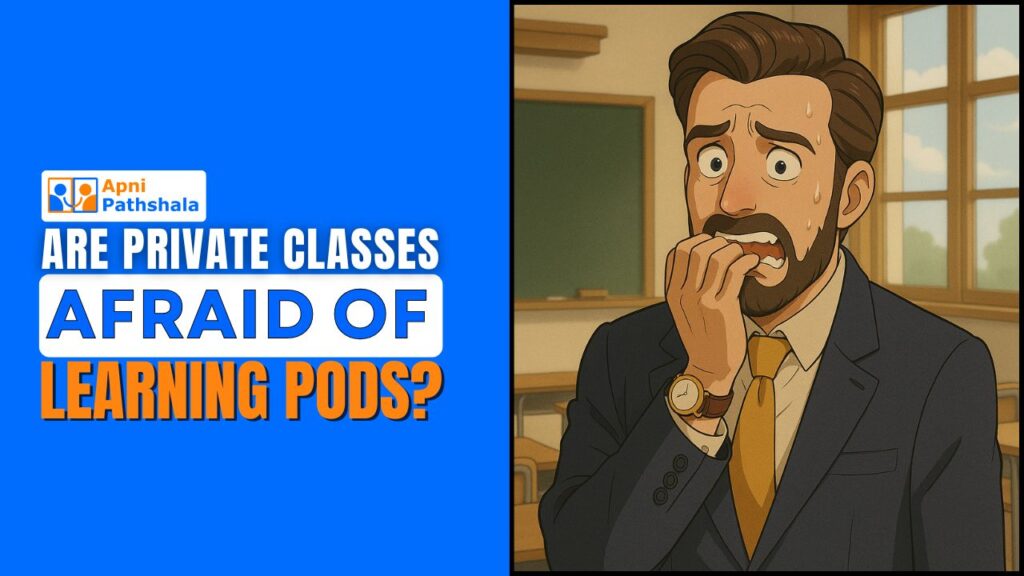
And why some private classes feel threatened.
This blog is not written to target any private classes or edtech platforms.
Many of them do incredible work and genuinely help students grow.
Our concern is only with those models that make education a privilege, accessible only to those who can afford it.
We believe learning should be fair, affordable, and available to every child. Our goal is to highlight the systems that limit education, not the educators who support students.
Let’s dive deeper.
How Apni Pathshala Changed the Game

At Apni Pathshala, we don’t sell expensive products or fees.
We give PODs:
- 10 powerful computers – Apna PCs at no cost, lease
- Curriculum guidance
- Software Support and Mentorship
- A huge community network of PODs and leaders
(Read to find out: Does Apni Pathshala Provide Free Computers?)
Unlike most NGOs that rely only on basic computer training, our PODs level up with:
- Coding
- Digital literacy
- AI learning
- Graphic design
- Game development
- Peer learning environments
- Project-based learning
And they deliver it at a cost so low that private tuition centres cannot compete.
This is the real reason the traditional market is nervous.
Why Private Classes and Edtech Platforms Can Fear the POD Model
Private classes and edtech companies can be afraid of Learning PODs because the POD model challenges the foundation of their business: high prices for essential digital education.
For years, private institutes created the belief that quality digital learning must be expensive, and parents accepted it because they had no alternatives.
But Learning PODs broke this illusion by offering the same (and often better) digital skills, coding, AI basics, computer literacy, projects, and job-ready courses, at a fraction of the cost, or even free in NGO PODs.
What worries the market more is that PODs provide community-driven learning, strong mentorship, and practical exposure. Students trust POD mentors more than commercial tutors, and PODs build local ecosystems that remain sustainable without selling overpriced courses.
This combination of affordability, quality, and community impact is something some private classes cannot compete with, and that’s exactly where the fear begins.
(Read our blog on Rising Private School Fees in India)
Which Types of PODs Worry Private Classes the Most?

Not all Learning PODs create the same kind of pressure on some private classes. But some PODs stand out because they offer high-quality learning at prices students can actually afford.
NGO PODs can make private institutes uncomfortable because they offer strong digital learning completely free, reaching students who were never part of the paid learning market.
Once these NGOs join Apni Pathshala, their teaching level rises, and they start offering skills that some private classes usually charge high fees for.
School-based PODs may worry private classes because they offer real digital education as part of the regular school day.
When students learn coding, computers, and AI, and do projects at school, they often don’t need extra classes outside.
Individual Leader PODs are another strong challenger. These PODs are driven by passionate community leaders who understand local needs.
They teach a wide range of skills, including basic computers, coding, graphics, and AI tools, at prices far lower than commercial centres.
But the PODs that private classes fear the most are the Self-Sustained (For-Profit) PODs. These PODs operate like high-quality, low-cost digital learning centres.
They teach everything from game development to full coding courses, stay profitable, and still remain affordable for families.
This balance of quality + low pricing is exactly what makes some private institutes nervous.
In short, PODs worry private classes because they prove what the market never wanted parents to believe:
Quality education does not need to be expensive.
PODs Are Not Disrupting the Market, They Are Fixing It
Learning PODs are not here to destroy the education market; they are here to repair it. India has one of the largest young populations in the world, and yet most of them cannot afford high-priced coaching or edtech subscriptions.
PODs bring fairness back into the system by making digital learning accessible, practical, and community-centred. Instead of creating financial barriers, PODs create learning opportunities.
They don’t replace private classes; they give students a meaningful alternative where learning is shaped by real needs, not profit margins.
Students learn what interests them, free from a curriculum trap.
Read this blog to see how students become mentors in these Learning PODs.
Are you aware that we are improving this system by using impact clusters?

What is Impact Clusters (IC)
To make sure every POD grows in the right direction, Apni Pathshala introduced Impact Clusters (IC), a structured way to classify and guide PODs based on the kind of learning they provide. Each POD gets clarity on its purpose, curriculum path, and growth plan.
Impact Clusters help POD leaders understand what to teach, how to measure progress, and how to solve student challenges effectively.
It ensures every POD, whether NGO-led, school-based, or self-sustaining, follows a meaningful path that leads to real impact in the community.
(Read our blog on How Impact Clusters Can Change Learning Forever)
Conclusion
The rise of Learning PODs is not a threat to the education system,
It is a correction, a gentle reminder of what learning was always meant to be:
fair, accessible, community-driven, and truly helpful for students.
For too long, many families believed that quality education must come with a high price.
PODs break that belief.
They show that a small room, a caring mentor, and a few computers can open the same doors that expensive coaching centres promise.
As PODs grow, they empower students, uplift families, and give communities a chance to learn skills that shape their futures.
At Apni Pathshala, we believe education is not a business it is a responsibility.
Every POD we support creates a ripple of change that reaches far beyond the classroom.
We need your help to support learners.
Share this blog to spread the word that change is happening, and you can
👉Start a POD in your community,
Explore our Recommended Courses👈.



One Response
A powerful reminder that the real disruption in education is not technologyit’s accessibility. Learning PODs show that students don’t need high fees or fancy branding to learn future-ready skills.
NGO PODs, school PODs, individual leaders, and self-sustained PODs are rebuilding trust in learning, one community at a time.
If this is the future of education, it looks a lot more fair and a lot more human.