
Introduction
Most people think children struggle in school because they’re lazy or “not interested.”
But if you sit quietly and observe a child outside the classroom, you’ll see something different.
A child can learn a new game in minutes.
A child can remember an entire song without effort.
A child can watch a video once and explain the whole thing to a friend.
So the real question is:
Is the child unable to learn, or is the system unable to teach the way children naturally learn?
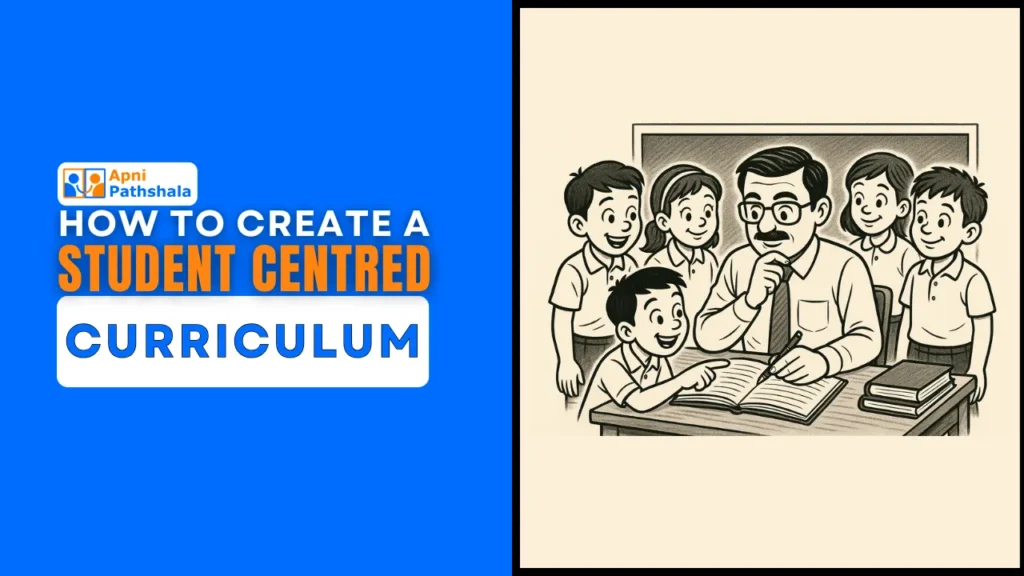
This is where the idea of a Student Centred curriculum begins.
Not a curriculum designed by adults sitting in a boardroom…
but a curriculum shaped by the child’s curiosity, the community’s needs, and the teacher’s understanding.
In this Blog, we will give a complete guide to making this kind of curriculum. But this guide is special: we will show the way, but the reader must do the necessary thinking and action to put it into practice.
Now let’s dive in.
What Is a Student Centred Curriculum?

A student centred curriculum places the student at the core of learning. It emphasises interests, needs, learning styles, pace, goals, and strengths, not marks, tests, or deadlines. In simple words:
It teaches the way children naturally learn, not the way the system forces them to.
A strong student-centred curriculum includes:
| Feature | Description |
| Personalisation | Every child learns differently |
| Adaptive learning | The curriculum adjusts to the student |
| Active learning | Learning by doing, not memorising |
| Peer learning | Students teaching and helping each other |
| Collaborative projects | Teamwork and real problem-solving |
At Apni Pathshala, with more than 120 Learning PODs across India, we have seen exactly what works and what doesn’t.
We’ve seen the barriers children face and the environment that genuinely helps them grow.
That is why we created our Impact Clusters. Read our blog to know more.
Bonus: The National Curriculum Framework for School Education (NCF-SE) 2023 can serve as an impactful blueprint for operationalising the student-centric vision of the National Education Policy (NEP) 2020.
Now, let’s understand how YOU can create a student-centred curriculum that actually works.
How to Create a Student Centred Curriculum

Remember:
This is not a traditional curriculum. Oak Meadow Samples
So the method will not be traditional either.
We follow a simple 3-step system:
| ANALYSIS | PLAN | CREATE |
Let’s go step by step.
1. ANALYSIS (Research Stage)
a) Understand Community + Demographics
Know the type of area (rural/urban/semi-urban) and the lifestyle of families (income levels, work backgrounds, digital access). This reveals what learning support children realistically need.
b) Understand Age + Local Needs
Younger children learn through curiosity; older ones learn through identity and goals. Combine this with local needs like digital literacy, basic computer education, job skills, creativity, and AI readiness.
c) Student Voice + Market Research
Talk directly to students, ask what they want to learn, what scares them, and what excites them. Then study what skills are in demand in your area. Choose subjects that fit BOTH research and student interest.
A bonus tip: if possible, take parents’ reviews on what their children should learn.
This becomes your foundation.
2. PLAN (Designing Stage)
a) Set Goals + KPIs
Decide what students should achieve (digital skills, reading/writing, confidence, AI tools, project completion). Then set simple KPIs to measure progress so you know what’s working and what needs adjusting.
b) Slice Topics + Organise Subjects
Break goals into small tasks and arrange subjects from easy → moderate → advanced. This helps students learn step-by-step without feeling overwhelmed.
c) Activities + Projects + AI Tools
Use interactive methods like discussions, hands-on tasks, peer learning, and one meaningful project per subject. Use AI tools like ChatGPT, Gemini, NotebookLM, and Perplexity to refine lesson plans and create structured content quickly.
d) Student Participation
Involve students in choosing topics, project ideas, and learning goals. This makes the curriculum genuinely student-led.
A bonus tip: make sure you store all the data and plans offline as well as in online documents and a drive.

3. CREATE (Building Stage)
a) Curriculum Book + Adaptive Path
Put everything into one document: goals, topics, activities, projects, KPIs, schedules, and flexible “adaptive paths” for different learning speeds.
b) Use AI for Structure + Build Project Tasks
Ask AI tools to convert your data into weekly and monthly lesson plans. Create project tasks that show creativity, skill development, and problem-solving.
c) Finalise With Students
Share the curriculum with students, what they’ll learn, how they’ll learn, and what choices they have. When students understand the plan, they take ownership.
Here are some samples of curriculum made with students:
| Topic | Curriculum Sample |
| Basic Computer | 30-Day Basic Computer Learning (With Videos) |
| AI Fundamentals | 30-Day AI Fundamentals Program |
| Google Workspace | 30-Day Google Docs & Google Workspace Learning |
Read the “Curriculum for Your Learning Pod” blog if you are developing a curriculum for your learning POD or classroom.
Conclusion
This is just one guide; there are many ways to build a student-centred curriculum.
But the heart of all methods remains the same:
Students must be involved.
Students must be heard.
Students must be the centre.
Because you are not creating a curriculum for a school.
You are creating it for students.
Once you finish designing your curriculum, implement it.
A plan only has power when it is used.
And when you succeed in building a student-centred curriculum, help other mentors do the same.
Share your experience. Share your method. Share your learnings.
Because one teacher changing their curriculum impacts one classroom.
But many teachers change the impact on a generation.
If you want to explore more:
- Read our blog on Can a Classroom Be Free from the Curriculum Trap? to understand adaptive learning.
- Visit our Blog Section to explore more guides.
- And if you want to create a student-first learning environment in your community, Start a POD today.
Let’s create learning that truly belongs to the learner.



One Response
This blog was very easy to understand. It explains why children do not learn well in the normal school system and how a student centred curriculum can help them learn better. The steps are simple and clear, and anyone can follow them. I liked how it shows that students learn faster when we listen to them and involve them in the plan. This guide feels practical, not confusing. It can really help teachers and POD leaders make learning more useful for children.