
Introduction
Have you ever wondered what makes a classroom successful?
Is it the number of students?
The subjects taught?
Or something else entirely?
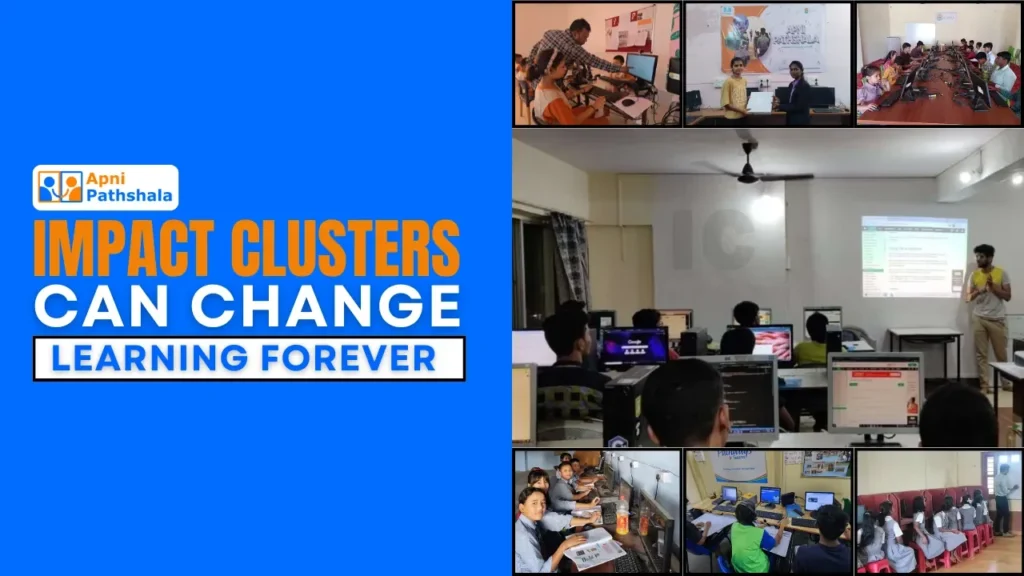
At Apni Pathshala, we’ve worked with more than 121 learning centers across 22 states in India. These centers, which we call PODs, are like small classrooms where students learn digital skills and much more. We’ve found that while all PODs have a common goal, they take different approaches that lead to various success factors.
Some PODs work with schools. Others are run by organizations helping underprivileged children. Some charge low fees, while others offer their services for free. Each one has its own story, its own students, and its own dreams.
But here’s the challenge we faced: How do we help all these different PODs when each one is so unique? How do we understand what they need without forcing them to be something they’re not?
That’s when our team came up with an innovative concept called Impact Clusters. But before we go to the Impact Clusters, let’s dive into which types of PODs we work with.
The Four Types of PODs We Work With
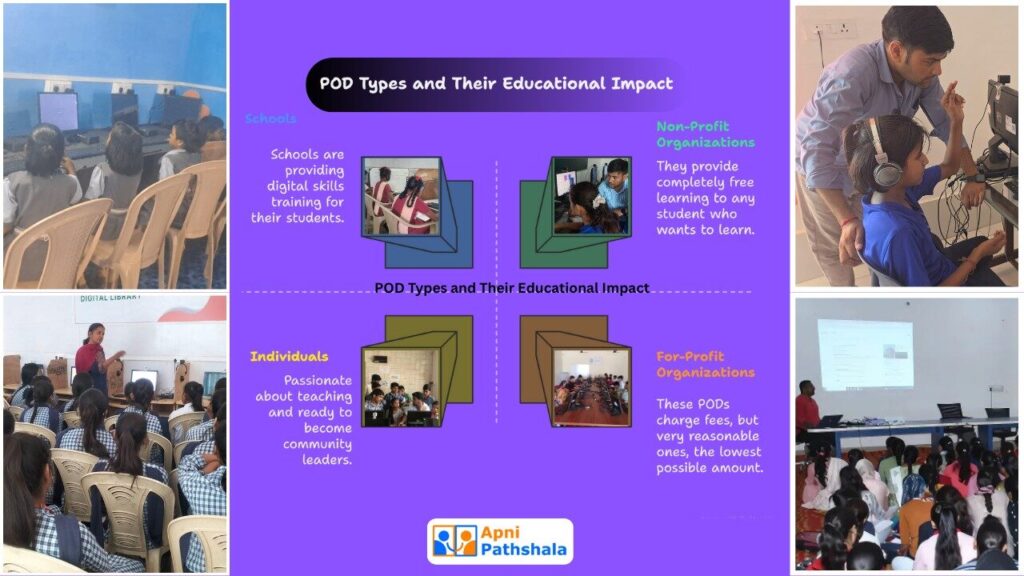
Apni Pathshala has four main types of PODs. Each type is different, but they all share an important goal. That goal is to help every student learn and grow, no matter their background.
Non-Profit Organizations (NGOs)
These are the true warriors of education. They provide completely free learning to any student who wants to learn. They raise money through donations and grants to keep their doors open. Imagine a place where a child from any family can walk in and start learning computer skills without paying a single rupee.
For-Profit Organizations (NGOs)
These PODs charge fees, but very reasonable ones, the lowest possible amount. They want to cover their basic costs while still making quality education available to students who can’t afford expensive computer classes.
Schools
We partner with both government and private schools to bring digital skills training to their students. Many schools want to teach computer skills, but don’t have the right tools or guidance. We help them make traditional learning more interesting and practical. Our focus is on schools that need digital literacy support, so we can reach as many children as possible.
Individuals
Some people have big hearts and even bigger dreams. These are individuals who are passionate about teaching and ready to become community leaders. We support them in setting up and running PODs, helping them bring quality digital education to their neighborhoods.
Apni Pathshala’s long-term goal is to find and support these community heroes, who are passionate about transforming education in their regions.
Every POD has its own path. But to truly help them grow, we needed a way to group them by purpose, not just by name or type. That’s where Impact Clusters came in.
What Are Impact Clusters?
We had a challenge because each POD is different. Some work in villages with just a few computers, while others help students get jobs in cities. Success varies: for some, it’s teaching basic computer skills; for others, it’s job placement.
We needed to figure out how they measure success, so we created Impact Clusters to group them by their goals. We identified four different Impact Clusters.
What is an Impact Cluster?
An Impact Cluster is a grouping of PODs that share similar objectives, categorized into four distinct groups based on their learning impact. This approach simplifies achieving success, understanding challenges, and providing the right support.
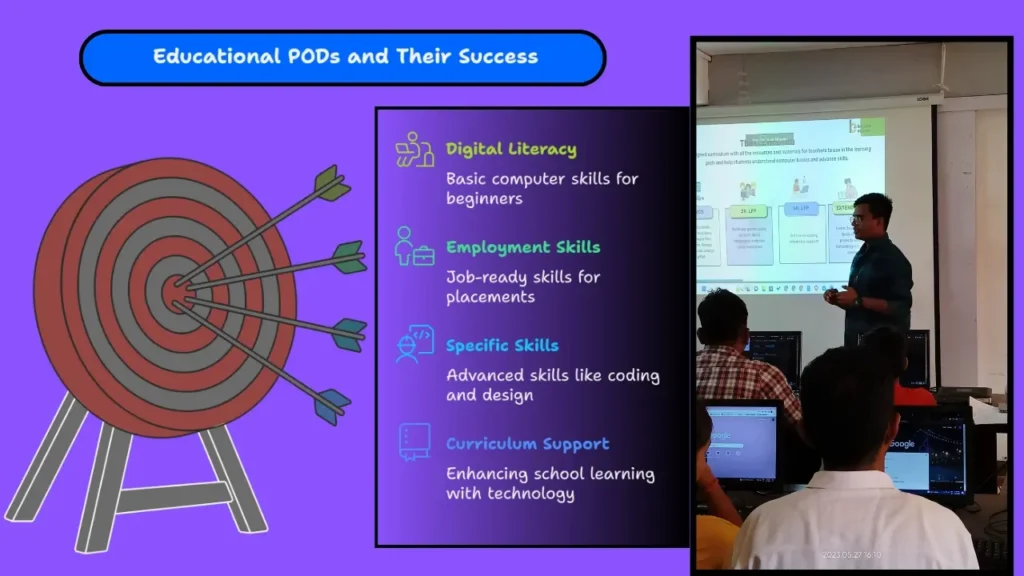
We identified four Impact Clusters, and every POD fits into one of them:
1. Digital Literacy Cluster
These PODs work with students who are taking their first steps into the digital world. These PODs work with students from rural or underprivileged backgrounds who are new to computers. Their goal is to make sure every student can use a computer confidently, type, search online safely, and understand basic software.
Their success: When students finish a basic digital literacy course and can use technology on their own.
Read about how Techveer transformed the Police Colony.
2. Employment Cluster
These PODs focus on a single, clear goal: helping people secure placements. Many young people struggle with using technology at work, and students want skills to earn money and support their families. These centers teach job-ready skills like email writing, freelancing, digital marketing, and interview preparation.
Their success: When students get a paid internship or job placement.
Discover Ambrish’s Inspiring Journey.
3. Skill Cluster
These PODs go deep into specific skills instead of teaching general subjects. Some teach coding, others focus on video editing, game design, or web development.
Their success: When students finish real projects or earn certificates that prove their skills.
Read about how a taxi driver’s son learned digital skills without his own PC.
4. Curriculum Support Cluster
These PODs support school-based learning. They help students understand subjects like math, science, and English using digital tools and visuals. It’s a hybrid learning model that combines traditional school books with smart learning techniques.
Their success: When students perform better in exams and understand concepts more clearly.
Explore How a Small Digital Hub is Transforming Rural Education in Haryana!
Why Impact Clusters Matter
Impact Clusters make it easy to:
- Understand what kind of help each POD needs.
- Showcase real success not just by attendance, but by impact.
- Build focused programs for specific learning outcomes.
- Keep every POD unique, while still making the whole system stronger.
In short, Impact Clusters help us make sure every POD moves in the right direction, with clear goals and purpose.
Conclusion
Think about it this way: Before Impact Clusters, it was like trying to give the same medicine to everyone without knowing what their illness was. Now, we can understand exactly what each POD needs and provide the right support.
This is just the beginning of our experiment. We’re building structure, providing better help, and making sure every POD is walking on the right path toward their goals.
This is part of our bigger initiative called M.A.H.E.S. support, which stands for Mentorship, Autonomy, Hardware, Exposure, and Software. Each letter represents a different way we help PODs succeed.
If you have attended any computer learning center,
What do you think?
Which cluster do you believe it can fall under?
Share your thoughts in the comments!
Ready to learn more?.
- Discover the real impact of PODs by checking out our success stories.
- Visit Apni Pathshala’s page to explore our recommended top courses for students
- Share this blog with someone who cares about making education better for everyone.

4 Responses
Aaj kuch naya sikhne mila. didn’t knew this concept. nice explanation.
It’s great that this helped you learn something new today, Amruta.
Sad Reality of Free vs Paid Learning
This difference affects learning more than we often realize. You can read the full blog in our blog section.